Wow, what is it that wonderful smell? I smell NFL football in my immediate future and my Steeler blood lust has taken over. I’m already holding high hopes for a truly successful season this year. I’ve hung my Terrible Towel collection in my man-cave and I’m praying for a gut-busting season similar to the years with Terry Bradshaw, Big Ben Rothlisberger, and the old and hopefully new Steel Curtain. With that in mind, how about some historical football trivia to whet your whistle.
As 1944 opened, the United States was deeply involved in World War II. Of the millions of Americans overseas, many thousands were in North Africa, which had been freed from Axis control during 1943. It happened that several units stationed in North Africa had formed a kind of North African Football Conference. The two top teams in this league wanted to play in an “Arab Bowl.” Other officers and men wanted a game between the Army and the Navy soldiers instead. Finally, a compromise was reached. Why not have a football doubleheader? The first game was to be played by the Casablanca Rab Chasers against the Oman Termites, for the North African Football Conference championship.
On January 1, 1944, it was a very hot day in Oran. In a rugged opening game, that Casablanca Rab Chasers defeated the Oran Termites for the title. And then another problem arose. Neither of these teams would lend their equipment to the teams for the Army-Navy game. Shoulder pads and jerseys were so hard to get at that time and were just too valuable to lend to strangers. It was decided that the second game would be played without equipment, it would be a touch football game between the Army and Navy, and blocking was permitted. Also, they announced the halftime entertainment would be camel and burro races, with members of the Women’s Army Corps and Red Cross nurses mounted on the animals. The selection of the beauty queen was declared a tie between three WAC contestants. Since no one had pads, the ground game was mostly end runs and passes. Nobody was really hurt by the blocking, but the heat caused many substitutions. The Navy scored on a blocked punt and a pass. The kick was good and made the score 7-0. Army tied the game before the half ended. The second half was scoreless until the last minute of the game when Army’s Eddie Herbert intercepted a pass and returned it to the Navy twenty-yard line. With time for one more play the kick split the uprights and Army won the game 10-7.
I’m sure that the men who played in that game remember it more fondly than any Super Bowl they’ve seen since. All that fun without an overpaid celebrity showing boobs or moonwalking during the half-time show.
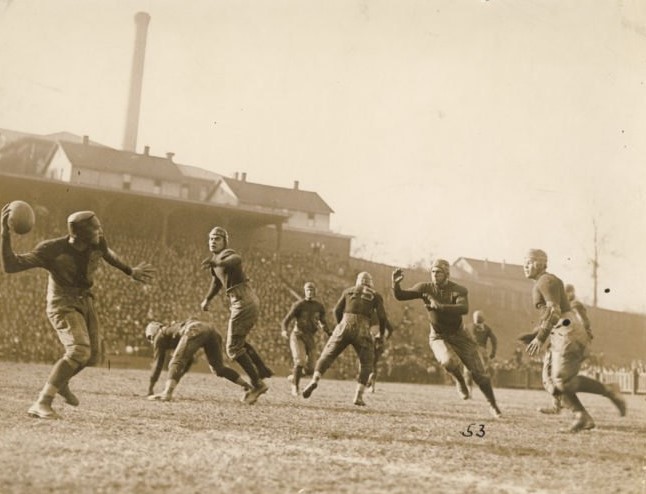
It’s unusual for me to post about sports but occasionally I do so anyway. My favorite sport by far is baseball but over the years football has wormed its way into my life. It all started back in the seventies with the “Steel Curtain” and the “Immaculate Reception” and my one and only hometown team the Steelers. Football has slowly become Americas pastime by not so gently nudging baseball aside. Today I would like to do a short history lesson about football, it’s origins, during the years 1861 – 1946 (my birth year). Read on, you may learn a few interesting things beacuse I certainly did.
1861: The first documented football game that was essentially rugby and was played at the University of Toronto..
1874: McGill University and Harvard play a hybrid version of rugby. The rule changes affect the game in the United States.
1875: The official game ball becomes an egg-shaped rugby ball. The field is now 100 yards long by 53.5 yards wide and teams are cut to 15 players per side referees are also added to the game.
1876: With the addition of the crossbar official goalposts now look like the letter “H”.
1880 – 1885: Game fundamentals are introduced such as the down system (going 5 yards in three downs equals a first down), along with a scrimmage line and yard lines. Teams are now eleven to a side. A field goal is worth five points, a touchdown and conversion, four points each, and a safety is two points. The first play calling signals and planned plays are introduced.
1894: The officiating crew is increased to three; a referee and two bodyguards, also known as the umpire and linesman.
1896: Only one backfield man may now be in motion before the snap, any can be moving forward.
1897: A touchdown now counts as five points.
1909: Now a field goal is worth three points.
1910: Seven players must now be on the line of scrimmage when the ball is snapped, establishing the basic offensive formation concept. The forward pass becomes commonplace in college football.
1912: A rules committee determines that a touchdown is now worth six points and adds a fourth down. It is now practical to punt.
1922: The American Professional Football Association becomes the National Football League.
1932: The NFL begins keeping statistics.
1933: There is a major NFL rule change: the passer can throw from anywhere behind the line of scrimmage.
1934: The modern football takes its current shape after a gradual evolution from the oddly shaped egg like rugby ball.
1939: Helmets became mandatory in college football, and the pros followed within a decade.
1941: It’s the end of the dropkick era. Ray McClean boots a conversion off the turf in the NFL championship game. In 2005, Doug Flutie created a sensation by doing it once again.
1946: The NFL’s first major rival league, the All-American Football Conference begins play. It lasts just four seasons with the Cleveland Browns winning all four titles.
It took another eight years before I realized from my father that I had been born a Pittsburgh Steeler fan. I first became a rabid baseball fan of the Pittsburgh Pirates for the next 20 years. Slowly but surely football reached out and grabbed me and when the 1970’s hit I was hooked. Unfortunately, I haven’t had much to cheer about with the Steelers in recent years. I was fortunate enough to move to New England and got to enjoy all of the years of Tom Brady and the Patriots. My allegiance wavered when Brady moved to Tampa Bay, but everything must come to an end at some point. Now I’m what would be called a fair-weather fan.


 everyuselessthing.com