I’ve always thought of myself as being a well-read and informed person. I’ve been an avid reader from a very early age and I’ll read anything I can from matchbook covers to the Bible, Koran, Torah, even the Egyptian Book of the Dead. So, when I discover backstories of everyday normal things, I become amazed and stunned at how much I really don’t know. Todays post will give you two examples of amazing backstories. See what you think.
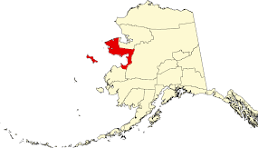
#1 – Here’s the question – How did Nome, Alaska get it’s name?
It was just a stupid spelling error. In the 1850’s a British ship exploring the coast noticed a prominent but unnamed point of land in Alaska. A ships officer scribbled “Name” next to that point on a manuscript map. When the map was being copied later at the Admiralty, a map maker misread thescribble andwrote the points new name as Cape Nome. In 1899 the burgers of Nome attempted to rename the area as Anvil City, but the all knowing U.S. Postal Service objected claiming it would cause confusion with the nearby town of Anvik, so the name stuck. To quote the cities website www.nomealaska.org, “There’s No Place like Nome”.
#2 –Here’s the question – What man-made artifacts can be seen from the moon?
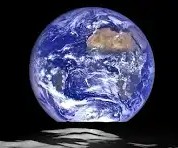
If you said the Great Wall of China you’d be wrong. No human artifacts at all can be seen with the naked eye from the moon. The idea that the Great Wall is the only man-made object is all-pervasive, but it confuses the moon with space. Space is quite close and starts at approximately 60 miles from the earth’s surface. However, at an altitude of only a few thousand miles after leaving the earth’s orbit, no man made objects are visible at all. From the moon – more than 250,000 miles away – even the continents are barely visible. Now you know that somewhat disappointing and incorrect trivia is wrong.
I’ve been fascinated for decades about anything related to space travel. I can thank my mother for that when shortly after Sputnik made its appearance she showed up in my bedroom with paint brushes and paints. She then proceeded to turn my bedroom into a huge space mural filled with planets, stars, meteorites, and spaceships.. She knew I loved anything related to space travel because I was already a sci-fi junkie at the ripe old age of five. Today’s post contains information that I’ve picked up along the way concerning the space race and weird little factoids that you may never have heard before. I hope you enjoy them.
Our galaxy is so wide that, at the speed of light, it would take you 100,000 years to cross it.
A meteorite the size of the school bus would destroy the entire eastern seaboard of the United States.
The volume of the Earth’s moon is the same as the volume of the Pacific Ocean.
A solar flare is basically a gigantic magnetic arch-like horseshoe magnet-that attracts itself inward, back to the surface of the sun.
The famous Halley’s Comet returns to earth every 76 years. It last appeared in 1986 and will reappear here again in 2062.
A solar flare, ejected from the sun’s surface, can reach speeds of 190 miles per second or 306 kilometers per second.
It takes 3 minutes for the sunlight that is reflected from the moon to reach our eyes.
Astronauts are not permitted to eat beans before they go into space because the methane gas released while passing wind can damage spacesuit materials.
A light-year is the distance light travels in one year or 870,000,000,000 miles or 9.4 5 trillion kilometers.
A Martian day lasts 24 hours, 37 min., and 23 seconds. And Earth Day last 23 hours, 56 min., and 4 seconds.
🔭🔭🔭
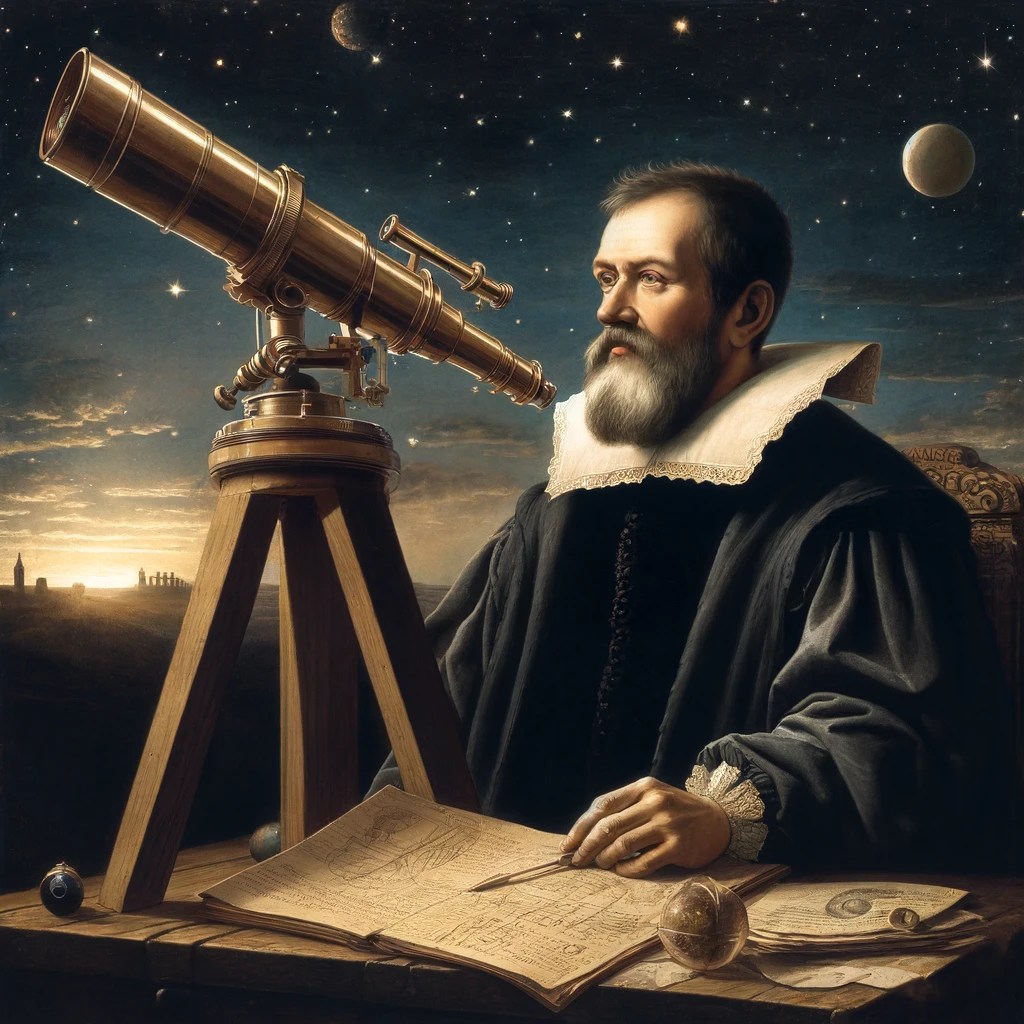
Here’s a salute to one of the greatest minds of all time.
Galileo Galilei
Here’s fair warning to some of you out there with outrageous or ridiculous theories. Galileo got into trouble with the Inquisition for his many theories, and spent some serious time in prison. The fact that he was correct made no difference.
With space travel once again becoming fashionable, we can thank the SpaceX corporation. Not only have they been innovative, but they’ve also become a thorn in the side for NASA. It’s good for the country to finally have a competitor for NASA that is quite simply “kicking their butt” and giving the big finger to the Russians as well. I foresee China as eventually becoming the leader in all things space-related unless some catastrophe slows them down a little. Unfortunately, I don’t see them reacting to disasters as we do. They would likely close ranks and keep right on going until their goals are met. Elon Musk will become their only real competitor for a time. With all of that in mind let’s check out a little “Out of This World” trivia.
A 150-pound earthling weighs in at 4200 pounds on the sun’s surface.
A lightning bolt on earth is hotter than the surface of the sun.
On Venus, the sun rises in the east and sets in the west.
Also, on Venus their day is longer than their year. It takes longer for Venus to rotate on its own axis than it does to complete one orbit around the sun.
NASA uses the same rocket technology used by TIE fighters in the Star Wars saga. TIE stands for “Twin Ion Engine” which propelled a deep space probe launched by NASA in 1999.
THE SUN
More than 1000 earths would fit inside Jupiter.
All the other planets in the solar system would also fit inside Jupiter twice.
Gravity is caused by a warping of space and time.
Time has not always existed. According to Einstein’s general theory of relativity, before the Big Bang, everything, including time, was packed together into an extremely tiny dot.
“Ten elite brains” is an anagram of Albert Einstein.
I am a huge fan of science fiction. I’ve spent most of my life reading everything I could concerning science fiction and the space program. I thought I’d post a few tidbits of information about our solar system and space program that you may not be aware of.
Miss Baker was the name of a 1-pound squirrel monkey sent into space aboard a United States missile in 1959. She traveled more than 10,000 mph to an altitude of 300 miles and had little trouble with liftoff, reentry, or weightlessness, which were extremely important test results for the upcoming manned missions. Apparently being the first monkey in space made her a little feisty. Upon recovery, she bit the person who removed her from the capsule.
Here’s how to figure out how much you weigh on another planet. Multiply your weight by the “gravitational pull” factors. If you weigh 97 pounds on earth and want to compare that to your weight on Mars, multiply 97 x .38. You would weigh about 37 pounds on Mars.
Our sun is considered a yellow dwarf star and it’s estimated to have a lifespan of at least 5 billion more years. At the end of its life, our sun will turn into what’s called a white dwarf star and will collapse under its own weight. Be glad you won’t be around for that.
We all know there are eight (formerly nine) planets revolving around our sun: Mercury, Venus, Earth, Mars, Jupiter, Saturn, Uranus, Neptune (Bye, Bye Pluto). There is a memory trick used by most space lovers to help remember the planets. Use this sentence: My Very Eager Mother Just Served Us Nine Pizzas. I wish I would’ve known that sentence when I was in school, it would’ve made things a little easier.