I’ve spent the last five and a half years being tended to by a score of doctors and nurses and it saved my life. It’s given me time to really examine their profession and the the abilities they have to save lives. Todays post will introduce odd facts and historical information where the roots of our current medical treatments began. Some of it is a little strange and also a little frightening but that’s how we’ve learned the skills being used today.
The first image of the doctors stitching up a wound can be found on the Edwin Smith Papyrus (1600 B.C.).
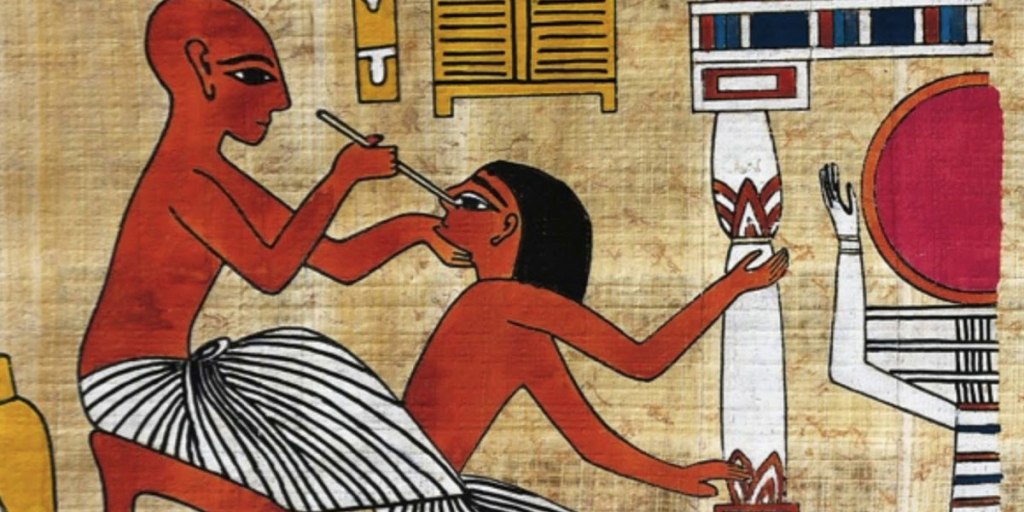
Ancient Egyptian medicine was considered so advanced that the rulers of neighboring kingdoms would often bribe, cajole, or even send someone to kidnap the Pharaoh’s best doctors.
The 3000-year-old “Ebers Papyrus” was written on a 65 foot long scroll and describes treatments for the eyes, skin, extremities, and organs. It also lists medicinal plants such as mustard, saffron, onions, garlic, thyme, sesame, caraway, and poppy seed, and offers more than 800 recipes for their use.
The Egyptians used opium as crude forms of anesthesia when operating on patients. They also created a milder painkiller by mixing water with vinegar and adding ground Memphite stone. The resulting “laughing gas” was inhaled.
The first known surgery for cataracts was performed in the Egyptian city of Alexandria in about A.D. 100.
A collection of 37 surgical instruments is engraved on the wall in the Egyptian Temple of Kom-Ombo (2d century B.C.). Some show amazing similarities to modern surgical instruments and includes scalpels, scissors, needles, forceps, lancets, hooks, and pincers.
The original Hippocratic Oath was written by a school of philosophers known as the Pythagoreans and was actually a reaction against the writings of Hippocrates. The Pythagoreans were conservative and even backward looking in many ways forbidding many medical practices, including the surgery.
The Romans considered cabbage to be a magically protective food. The philosopher Cato wrote that Romans should not only eat cabbage at every meal, but also drink the urine of someone who’d eaten cabbage two days before.
In both ancient Greece and Rome, doctors didn’t need licenses or any formal training to practice. Anyone could call himself a doctor. If his methods worked, he attracted more patients, if not, he found himself another job.
Most Roman surgical instruments were made of bronze, or occasionally of silver. Iron was considered taboo by both Greeks and Romans and was never used for surgical instruments on religious grounds.
This will be a fun post but not if you’re a germophobe. I can deal with just about anything, but these items still have the ability to make my skin crawl just a little. If I had to sit around and obsess about bacteria and mites infesting my body like my better-half does, I would lose my mind. Hang onto whatever you like to hang onto, this ride might get a little bumpy.
Itchiness in humans is contagious. Watching someone else itch makes your brain think it’s experiencing an itch, even when it’s not.
The average bed is home to 10,000,000 dust mites.
It goes without saying that every day you inhale thousands of you own skin flakes since you lose approximately 40,000 flakes per minute.
Your skin contains billions of individual bacteria.
The most common bacteria found in your belly button is of the same species that make your feet smell.
There are mites that live in your hair follicles, eyelashes, and eyebrows. They walk around on your skin at night before returning to their hair follicles during the day.
Tapeworms inside humans have been measured as long as 20 feet.
Fungi thrive on the protein keratin found in hair, nails, and skin.
Men and women fart approximately the same amount each day, a half-liter of gas a day.
Did you know that defecaloesiophobia is the fear of painful bowel movements.
(Did you know?)
FART IS ONE OF THE OLDEST WORDS IN THE ENGLISH LANGUAGE
Now that I’m laid up with this broken ankle, I thought I should delve into the medical profession for a few items of trivia. Unfortunately, most of my conversations these days are with doctors, nurses, hospitals, and those lovely insurance companies. I should mention that as a young kid I was bullied for almost a year which makes me very aware of people who bully others. I understand that medical folks are only trying to do good, but really their job is all about being gentle bullies and I tend to react badly at times. It makes me a little crazy. I’m sure that somewhere in one of the many medical computer files some well-meaning person has noted next to my name, “A-Hole“. So, sit back and enjoy some medical trivia from a proud, card-carrying A-Hole.
The Egyptian mummy was a standard drug of European pharmacology until the eighteenth century. Despite criticism within the medical profession, doctors prescribed mummy powder as a cure for internal ailments. Portions of many embalmed Egyptian dead were swallowed before science and common sense rendered the practice obsolete.
Sigmund Freud turned down a $10,000.00 fee in 1920 to spend six months in New York treating patients in the morning and lecturing in the afternoon. He calculated that he would return to Vienna poorer than when he left so he declined.
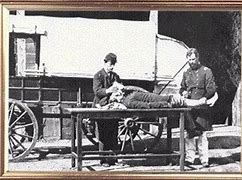
Opium was frequently used as a painkiller by Army doctors during the US Civil War. By the end of the war, according to conservative estimates 100,000 soldiers had become addicted to opium, at a time when the population of the entire country was only 40,000,000.
In the eighteenth century, there were American slaves who were physicians. They treated not only other slaves and free blacks and whites as well, until restricted by law to serving only the black community.
Approximately 3500 men were practicing medicine at the time of the American Revolution. Only about 400 had an actual medical degree. Of the much larger number of women who practiced, even a smaller number had any formal training.




 everyuselessthing.com