I love trivia that is unusual and odd. So today I’ll list a few items from one of the top three areas most requested from readers? SEX as always leads the list so for today, I’ll just eliminate FOOD & LIMERICKS. Here’s everything you need to know about SEX (LOL).
A recent survey revealed that 25% of Swedish women have had sex with more than 50 men.
The average sexually active woman has sex 83 times per year.
Sex burns off 360 calories an hour.
The heart beats faster during a brisk walk or a good argument then it does during sexual intercourse.
America’s first manufactured condoms appeared in 1870 and were made of vulcanized rubber. They were thick, insensitive, and intended to be reused.
Men are four times more likely to sleep in the nude than women.
One in every 300 births in the United States occurs in a vehicle.
11% of women and 5% of men claimed never to have masturbated.
The last few days have been fugly and for those of you that don’t know what that means I suggest you call someone. Sleet, freezing rain, ice, snow, regular rain, high winds, and temperatures moving up and down the scale from 9 degrees to 40 degrees. A little bit of everything you could possibly imagine and none of it you would ever ask for.
The ice storm early in the week was responsible not only for icy roads but for falling tree branches covered with ice and snow. We had two small trees down in the back yard but nothing too terrible. Other folks weren’t as lucky with collapsed roofs, damaged vehicles, and damaged shrubbery.
We took a ride around the area earlier today and these photos pretty much explain how Maine feels in the winter. This first shot is of what a prosperous farm looks like in Winter.
A very solemn sight to be sure. I prefer the corn to be green and growing and the machinery in operation. The next photos were taken along the Saco river with the first looking north with the sun at my back and the second facing south with the sun in my eyes.
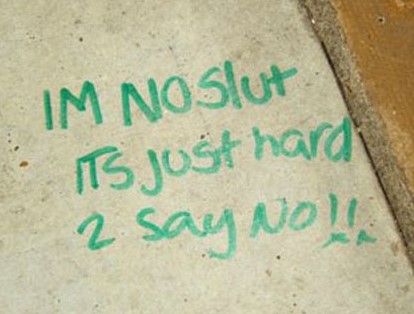
Regardless of the direction I’m looking that water is frigid, the cold wind was freezing my face, and I ran for my car when I was finished. The parking area near the river was covered in ice and it was purely luck I didn’t fall on my ass like I usually do. Through a bare spot in the ice I saw a reminder of Summer and of all the teenage kids who seem to congregate here. I don’t know who Jake is but an artist he aint!
I look forward to seeing more graffiti in about five months. I sure hope it’s better than this stuff.
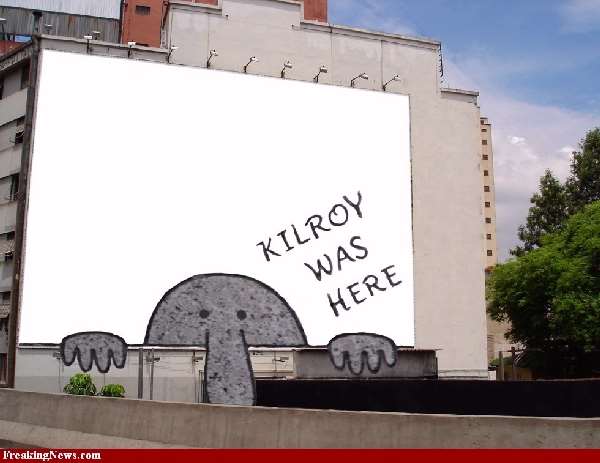
I grew up during the post WW II era period and I remember seeing Kilroy graffiti many times as a kid and later after my enlistment in the Army. I never knew the history behind it and never felt the need to find out. There was even a time or two when I painted that logo on a wall while stationed on bases in the US and even after my assignment to Korea I managed to leave Kilroy here and there. I’m sure many of you have seen Kilroy over the years and now it’s time to tell the whole story. Thanks to my friend Park from Kansas City who supplied much of this information.
* * *
You can find his likeness engraved in stone in the National War Memorial in Washington , DC at the rear of a small alcove where very few people have seen it. For the WWII generation, this brings back memories. For us younger folks, it’s a bit of trivia that is a part of our American history. Anyone born in 1913 to about 1950, is familiar with Kilroy. No one knew why he was so well known but everybody seemed to get into it. So who was Kilroy?
In 1946 (the year I as born) the American Transit Association, through its radio program, "Speak to America ," sponsored a nationwide contest to find the real Kilroy, offering a prize of a real trolley car to the person who could prove himself to be the genuine article. Almost 40 men stepped forward to make that claim, but only James Kilroy from Halifax , Massachusetts , had evidence of his identity.
‘Kilroy’ was a 46-year old shipyard worker during the war who worked as a checker at the Fore River Shipyard in Quincy, MA . His job was to check on the number of rivets completed. Riveters were on piecework pay scale and got paid by the rivet. He would count a block of rivets and put a check mark in semi-waxed lumber chalk, so the rivets wouldn’t be counted twice. When Kilroy went off duty, some larcenous riveters would erase the mark. Later on, an off-shift inspector would come through again and count the rivets for a second time, resulting in double pay for those cheating riveters.
One day Kilroy’s boss called him into his office. The foreman was upset about all the wages being paid to riveters and asked him to investigate. It was then he realized what had been going on. The many tight spaces he was required to crawl into didn’t lend themselves to lugging around a paint can and brush, so Kilroy decided to stick with the waxy chalk. He continued to put his check mark on each job he inspected but added ‘KILROY WAS HERE’ in king-sized letters next to the check. He eventually added the sketch of the chap with the long nose peering over the fence and that became part of the Kilroy message.
Once he did that, the cheating riveters stopped trying to wipe away his marks. Ordinarily the rivets and chalk marks would have been covered up with paint but with the war on, however, ships were leaving the Quincy Yard so fast that there wasn’t time to paint them. As a result, Kilroy’s inspection "trademark" was seen by thousands of servicemen who boarded the troopships that the yard produced.
His message apparently rang a bell with our servicemen because they picked it up and spread it all over Europe and the South Pacific.
Before war’s end, "Kilroy" had been here, there, and everywhere on the long hauls to Berlin and Tokyo . To the troops outbound in those ships, however, he was a complete mystery; all they knew for sure was that someone named Kilroy had "been there first." As a joke, U.S. servicemen began placing the graffiti wherever they landed, claiming it was already there when they arrived.
Kilroy became the U.S. super- G I who had always "already been" wherever GI’s went. It became a challenge to place the logo in the most unlikely places imaginable (it is said to be atop Mt. Everest , the Statue of Liberty , the underside of the Arc de Triumphe, and even scrawled in the dust on the moon.
As the war went on, the legend grew. Underwater demolition teams routinely sneaked ashore on Japanese held islands in the Pacific to map the terrain for coming invasions by U.S. troops (and thus, presumably, were the first GI’s there). On one occasion, however, they reported seeing enemy troops painting over the Kilroy logo!
In 1945, an outhouse was built for the exclusive use of Roosevelt, Stalin, and Churchill at the Potsdam conference. Its’ first occupant was Stalin, who emerged and asked his aide (in Russian), "Who is Kilroy?"
To help prove his authenticity in 1946, James Kilroy brought along officials from the shipyard and some of the riveters. He won the trolley car, which he gave to his nine children as a Christmas gift and set it up as a playhouse in the Kilroy yard in Halifax , Massachusetts .






 everyuselessthing.com