With the NFL preparing to dazzle us with another season of football, I feel the need to give baseball a little extra boost because it’s my all-time favorite sport. It will always be Americas Favorite Pastime for me as shown by the continuing outstanding teams and players this season. Todays post consists of a short but extremely difficult trivia quiz (10 questions) that was initially prepared and published in 1975. It was created to challenge only the true fans of the game. As always, the answers will be listed below.
In 1926, who was the Brooklyn Dodger who “tripled” into a double play by being caught on third base with two other runners?
What Milwaukee pitcher committed two errors while covering first base, enabling the Yankees to win the 1958 World Series?
Who was the Cincinnati catcher who blocked an errant pitch with his body and then couldn’t find the ball – only three feet away – while two Yankees scored in the tenth inning of a 1939 World Series game?
Who was the New York first baseman who committed a three-base error in the 1939 World Series to set up a Dodger run which helped Los Angeles sweep the four game series?
Who made the boner – failing to touch second base on a teammate’s single – that cost the Giants a late-season victory and the 1908 pennant?
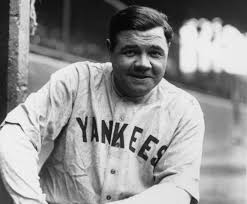
THE BAMBINO
What Dodger catcher missed holding on to a third strike which allowed Tommy Hendrich to reach first base safely and opened the way for a Yankee World Series victory in 1941?
Who was the Chicago Cub pitcher who threw Babe Ruth a homerun ball after the Bambino had taken two strikes and pointed to the spot over the Wrigley Field fence where he would hit the ball in the 1932 World Series?
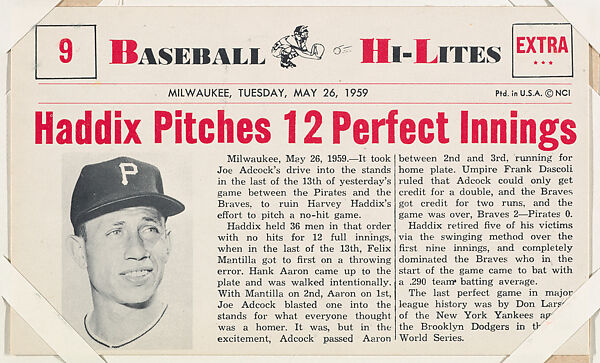
Only one pitcher has retired more than twenty-seven batters in a single game. Name him.
Who was the only man to complete an unassisted triple-play in the World Series?
The Yankee had two second base men who hit .500 in World Series play. One did it in 1941 and the second in 1953. Name them.
PLAY BALL!!!
Answers
Babe Herman, Lew Burdette, Ernie Lombardi, Joe Pepitone, Fred Merkle, , Mickey Owens, Charlie Root, Harvey Haddix (Pittsburgh vs Milwaukee 1959) 35 batters, Bill Wambsganss (Cleveland) 1920, Elston Howard and Gene Tenace
I thought on this rainy day we should revisit some retro baseball stories. These are two of my favorites and one of the many reasons I love baseball so much. The first story is something that was called The Five-Base Hit. The second is a story about a debt owed to Albert “Chief” Bender, an old-time pitcher. I hope you enjoy them.
Strange things happen in professional baseball, but even stranger things can happen in amateur sandlot ball. Harry Hardner was involved in one of the most peculiar plays possible in baseball.
Hardner’s Walnut Street team played on a field in Milwaukee that had no fences. No matter how far the ball was hit, it was in play until the pitcher had it back in his glove. In one game Hardner got a fat pitch and drove it far over the outfielder’s head. Hardner raced around the bags happily.
Just as Hardner crossed the plate, a teammate who was coaching at first base began shouting, “Run to first! “Run to first! The teammate and the opponent’s first baseman noticed that Hardner had failed to touch first on his way around the base paths.
Tired as he was, Hardner took off for first base again just as the ball came in from the outfield. He slid hard into the bag just as the throw arrived. The umpire called him safe. He was given credit for just a single. But his teammates always called it a five-base hit.
⚾⚾⚾⚾⚾
One of baseball’s greatest pitchers was an Indian named Albert “Chief” Bender, who pitched for the Philadelphia Athletics and Phillies. Bender won 208 games in the majors, but his own favorite story concerned a game he lost as a bush-leaguer. In 1901 Bender agreed to pitch his first professional game for the Dillsburg, Pennsylvania, team. He was to be paid five dollars. Even Bender had to laugh when he saw where the game would be played. It was a hayfield, with a cabbage patch in the outfield. Bender himself hit a home run into the cabbage patch, but he lost the game in the 10th inning. Afterward the manager handed the “Chief” $3.20 and said “we don’t have enough money. I’ll give you the rest the next time I see you.” 41 years later the “Chief” was being interviewed by Ed Pollock a reporter for the Philadelphia Bulletin. Bender recited the story and surprise, surprise, a few days later a letter and small canvas bag reached the Bulletin. The letter read in part:
Dear Sir: In going over our records we have an outstanding amount due you from the summer of 1901. Not knowing your whereabouts nor having seen you for all these years, we were unable to remit. The cabbages were harvested and sold later that year, giving us a small surplus. We are enclosing the money reserved for you.
In the canvas bag was a three-cent piece with the date 1864, a two-cent piece, two dimes dated 1875, 23 nickels, and 40 Indian-head pennies. The change added up to a $1.80, the exact amount Bender was owed. But the Dillsburg team was really being generous. The coins were very rare and worth a great deal more than their face value.