I’ve always been attracted to graveyards. There’s no better place to paint, sketch or write than the peaceful quietness of a graveyard. It’s one of the few places still left where someone can go and relax without interferences from the rest of the living human race. I once lived in a city called Lakeville in Massachusetts and for many years I was known far and wide by the police departments and many citizens as someone who was consistently haunting local graveyards. In the Plymouth area there are still tombstones from the 1600’s with some truly bizarre epithets and poetry. I just takes a little time and dedication to find them. Todays post will contain what some people would consider morbid information and that’s true, it is a little morbid but it’s still interesting. Being the kind and generous soul that I am, I’m willing to share.
😵😵😵
“Haircut!” Last words of famous gangster Albert Anastasia in 1957 while getting a trim.
“Smite my womb.” Spoken by Agrippina, mother of Nero, to the assassins sent to kill her by her son.
“The strongest.” Uttered by Alexander the Great when asked who should succeed him.
“The executioner is, I believe, an expert . . . and my neck is very slender. Oh God, have pity on my soul, . . . ” as she was beheaded.
“I hope so.” Stated by Andrew Carnegie, steel magnet and philanthropist, to his wife who’d just wished him a good night:
Epithets
Burlington, Massachusetts
Sacred to the memory of Anthony Drake,
Who died for peace and quietness sake;
His wife was constantly scolding and scoffin’,
So he sought for repose in a twelve dollar coffin.
As you are all aware collecting strange facts and stories is my life. It was also a hobby of one of my favorite writers, Isaac Asimov. I’ve mentioned him many times through the years because he was not only a prolific writer but a huge collector of obscure information. Today’s post will be information he collected about the deaths and actions of some interesting individuals. You need to remember that while he collected a lot of information, he was also a big history buff as well. Much of his information concerns people well-known from many years ago. See what you think.
The city morgue in the Bronx, New York, has been so busy at times that next of kin are required to take numbers like they’re in a bakery and then wait in line for their body identification call.
Through the door and windows, would-be assassins poured 73 bullets into Leon Trotsky’s bedroom in his fortresslike house in Mexico City. Thanks to a moment’s warning, Trotsky and his wife escaped unscathed by hiding under the bed. Later in the same year, which was 1940, Trotsky was slain by one man, using an ice pick, who worked himself into the confidence of the old Russian revolutionary. The assassin went by the alias Jacques van den Dreschd, but his true identity remains unknown to this day.
Someone maliciously shouted “Fire” at a copper miners Christmas party in Calumet, Michigan, in 1913. Panic ensued and 72 lives-mostly children’s-were lost.
Calumet Fire Disaster
Stephen Decatur, US naval hero of the Tripoli campaign and of the war of 1812, was challenged in 1822 to a dual by a fellow officer, Commodore James Baron, who was seriously nearsighted. To accommodate his opponent, Decatur agreed to exchange shots at only 8 paces. The duel began and Baron then killed him.
Francis Bacon (1561-1626), The Elizabethan champion of the scientific method, died in pursuit of a better way of preserving food. He caught a severe cold while attempting to preserve a chicken by filling it with snow and later died.
George Eastman (1854-1932) was born poor and had little chance for schooling. Thanks to the profit of the company he founded, Eastman Kodak, he was able to contribute over $100 million to various educational institutions. Eastman committed suicide rather than spending his last years in loneliness and without the prospect of further accomplishments.
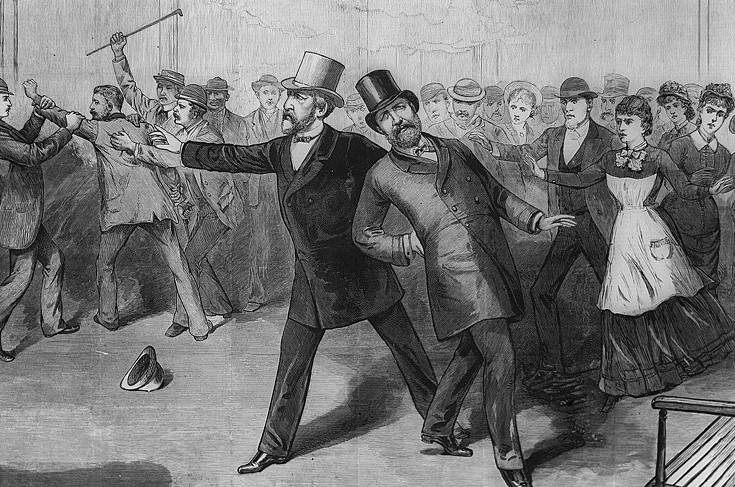
President Garfield Assassination
Alexander Graham Bell devised a metal locating tool to help find the assassin’s bullet in President James Garfield in 1881. The capture device was workable, but didn’t work on this occasion because no one had thought of removing the steel spring mattress the president was lying on. Metal, it turned out, interfered with the devices search. The unsanitary methods used in attempting to locate the bullet caused infection to spread throughout Garfield’s body and he died shortly thereafter.
Here are the final words of a favorite: Oscar Wilde
I can tell that today is not going to be a fun day. First of all, this is a “change of season” month, and I find from years of experience that “change of season” months usually suck. The clouds are gray, the sky is gray, the garden plants are all dead, all the “cool” birds have headed south for the winter, and I’m hip deep in effing leaves. Here’s my good survival tip for living in Maine. You must always and I do mean always have an electric blanket somewhere nearby for heat emergencies at this time of the year. Last night I earned a “7” out of ten on my electric blanket. I was awakened at 5:30 a.m. not for my normal bathroom visit but because my teeth were chattering so loud, I was waking up the cat. I’m just not ready for this crap weather and the coming winter. Maybe it’s just old age creeping up on me which tends to be happening more and more these days.
As the years go by, I’ve given a lot of thought to my final days, and I’ve discovered that only two things really matter at that point. If you want to leave some sort of legacy all you need to do is leave two things: a self-written epithet for your headstone or (for you urn people) a really cool quote for your final words. Today’s post is a list of the final words of a few well-known people. Some are profound and some are not, you be the judge.
H. G. Wells (1866-1946) stated to his nurse: “Go away. I’m all right.”
Brigham Young (1801-77) stated “Amen”.
George Washington (1732-99) stated to his doctor, “Doctor, I die hard, but I’m not afraid to go.”
Theodore Roosevelt (1858-1919) “Please put out the light.”
Pablo Picasso (1881-1973) “Drink to me.”
Elizabeth I (1533-1603) “All my possessions for a moment of time.”
So how would you all like to have a homework assignment. If you’re so inclined, send me your epitaph and last words and hopefully by then I’ll have mine done and will I’ll post them.
As a person ages and begins to deal with their own mortality they sometimes think about the final moments of their life. I’ve observed that death can also be a final moment of embarrassment for some. People who are celebrities of a sort must think that their final words may be released to the public and repeated forever. The last thing you want people to think is that you were frightened or stupid at the end. Unfortunately many times these final words do seem stupid, some humorous, and others make no sense at all. This collection of final words has been in my files for years and has always made me think a little and occasionally smile a lot. What willI say at the end? I’m not a famous person so it will only mean something to me and possibly the last person I talked to. No one else will care.
Let’s now take a few minutes and review some of these last utterances of some allegedly famous people:
“I don’t have the passion anymore, and so remember, it’s better to burn out than to fade away. Peace, Love, Empathy. Kurt Cobain.” Kurt Cobain (in his suicide note). Lead singer for American grunge band Nirvana, referencing a song by Neil Young.
“In keeping with Channel 40’s policy of bringing you the latest in blood and guts and in living color, you’re going to see another first – attempted suicide.” 30-year-old anchorwoman Christine Chubbuck, who, on July 15, 1974, during technical difficulties during a broadcast, said these words on-air before producing a revolver and shooting yourself in the head. She was pronounced dead in the hospital 14 hours later.
“It’s very beautiful over there.” Thomas Edison
“Now why did I do that?” Gen. William Erskine, after he jumped from a window in Lisbon, Portugal in 1813.
“Don’t worry, relax.” Rajiv Gandhi, Indian Prime Minister, told his security staff minutes before being killed by a suicide bomber attack.
“Dying is easy, comedy is hard.” George Bernard Shaw
“I’m losing.” Frank Sinatra
“My wallpaper and I are fighting a duel to the death. One or the other of us has to go.” Oscar Wilde
“I’m tired of fighting.”Harry Houdini
“I see black light.” Victor Hugo
“LSD, 100 micrograms I. M.” Aldus Huxley to his wife. She obliged and he was injected twice before his death.
“I’m bored with it all.” Winston Churchill, before slipping into a coma and dying nine days later.
“Dear World, I am leaving you because I am bored. I feel I have lived long enough. I am leaving you with your worries in this sweet cesspool – good luck.” (suicide note) George Sanders, actor
“They couldn’t hit an elephant at this distance.” Gen. John Sedgwick, Union commander in the US Civil War, who was hit by a sniper fire a few minutes after saying it.
After reading these final words I know I can do better. I just hope I have the opportunity to say something meaningful or humorous before I go. Not to be too morbid but you should really take some time to think about and write your own epitaph. Stand by for Part II of Famous Last Words . . . coming soon.
P.S. Here’s what I’ve decided should be my last words: “veni, vedi, cessi”. If Latin was good enough for Julius Caesar, it’s good enough for me. It translates to, “I came, I saw, I left”






 everyuselessthing.com