For many years I’ve considered myself a true “foodie”. I’ve always made a point to try damn near anything called food. Of course, that has changed dramatically as I’ve aged. Truthfully, I don’t really miss my entrees of “dog soup” and “cat spring rolls” I once tried in Korea. So, when I started collecting odd facts and trivia, food always seems to be mentioned in some fashion. Here are a few little-known facts about food I’ve collected. How many have your heard before?
What is the name of the dog on the Cracker Jack box? Bingo.
What is the American name for the British delicacy known as trotters? Pig’s feet.
Under US government regulations, what percentage of peanut butter has to be peanuts? 90%.
Who originally coined the phrase that has been appropriated as the slogan for Maxwell House coffee; “Good to the last drop”? President Theodore Roosevelt
What recipe did Texas ice cream maker Elmer Doolin buy for a $100 from the owner of a San Antonio café in 1933 and later used to make a fortune? The recipe for tasty corn chips that was later marketed as Fritos. He made them at night in his mother’s kitchen and peddled them from his Model-T Ford.
A California winemaker from Napa Valley once named a wine in honor of Marilyn Monroe. What was it called? Marilyn Merlot.
What food product was discovered because of a long camel ride? Cottage cheese. An Arab trader found that milk he was carrying in a goatskin bag had turned into a tasty solid white curd.
Peter Cooper, best known for inventing the locomotive “Tom Thumb”, patented a dessert in 1845. What was it? A gelatin treat that eventually became known as Jell-O when it was marketed in 1897.
In 1867 Emperor Napoleon III had a chemist develop a food product “for the army, navy, and the needy classes of the population.” What was it? Margarine.
What was the drink we know as the Bloody Mary originally called? The Red Snapper, which was it’s name when it crossed the Atlantic from Harry’s New York Bar in Paris.
I’m quietly sitting here trying to decide what football team I should post about. I won’t post about the Pittsburgh Steelers because they’re just too awesome for this website. But unfortunately, Fall is football time and I’m starting to get the bug in a big way. In recent weeks I watched some good games, some bad games, and some ridiculously bad games. I thought I’d do some research to see if I can find any games that weren’t all that good in past years. Here is what I found.
This is about the game between Georgia Tech and Cumberland college. Sometimes colleges schedule games that are complete mismatches where one of the teams has absolutely no chance of winning. This was the worst loss I could find. It was October 7, 1916, and Cumberland was in big trouble.
Georgia Tech was coached by the great Johnny Heisman, for whom the Heisman Trophy was named. Cumberland, a tiny school, was located at Lebanon, Tennessee, and had a total enrollment of only 178 students. The Cumberland team agreed to play only because Tech promised a cash guarantee for money that would help support future football at their school. But within a few minutes the Cumberland players regretted they had ever agreed.
The slaughter began almost immediately. After one quarter, Georgia Tech had scored nine touchdowns and led 63-0. At the end of the half the score was 126-0. Georgia Tech scored whenever and however they pleased. Once Ev Strupper, who scored six touchdowns in the game, ran the ball to the goal line, then stopped and put the ball down on the one-yard line. He wanted his teammate, Canty Alexander, to carry the ball over the goal line to get credit for the score. After scoring 126 points in the first half, Georgia Tech let up a little and scored only 96 points in the second half.
Today’s post is going to do the unimaginable and permit us to time travel back 84 years to 1940. This is going to be a rambling narrative of things that were happening at the time and will start with the top five movies of the day: Boom Town, Fantasia, His Girl Friday, Kitty Foyle, and Knute Rockne All-American. Strange as it seems I recently saw a couple of these movies being streamed and I spent an hour and a half watching His Girl Friday with Cary Grant. After all those years it was still fun to watch because Cary Grant was effing amazing.
Ginger Rogers earned the best actress at the Academy Awards. The movie Grapes of Wrath was huge, and Walt Disney’s animation began to become a force in the movie industry with Pinocchio and Fantasia. Tom and Jerry weren’t far behind with Hanna-Barbera releasing Puss Gets the Boot. The year also brought us two future celebrities: Smokey Robinson born on February 19 and Peter Fonda born February 23. With the Great Depression over, 1940 consumer food intake became more dependent on canned foods such as soup, meat and vegetables.
Air travel was on the rise and the NFL’s Green Bay Packers became the first team to travel by air. The TWA Transcontinental Airline introduced the Stratoliner to help promote more travel across the continent. The United States had yet to be drawn into the war in Europe. The 1939-1940 World’s Fair was held at Flushing Meadows-Corona Park in New York and was the largest world’s fair of all time.
In the world of sports baseball rapidly was spreading in popularity across the country. The Negro National League was steadily becoming more popular with teams like the Washington Homestead Grays (league champs), the Baltimore Elite Giants, and the Newark Eagles playing to large crowds.
Knute Rockne ruled college football with the University of Minnesota Golden Gophers being named the national champs. The Heisman Trophy winner was Michigan halfback Tom Harmon. The NFL Chicago Bears defeated the Washington Redskins 73-0, in one of the most one-sided games in professional football history.
In the early 1940’s cars began to take on a lower, longer and broader look. This new look fit in well with the luxury cars that were beginning to be produced. They were the La Salle Series 52, the Lincoln Zephyr V-12, and the Packard Custom Super-8 180.The Pennsylvania Turnpike was opened on October 1, 1940, and the first Los Angeles freeway was dedicated in December.
The entertainment industry released the top hits of 1940: In the Mood-Glenn Miller, Frensi-Arte Shaw, Only Forever-Bing Crosby, and I’ll Never Smile Again-Tommy Dorsey. The talk radio shows of 1940 listed The Adventures of Ellery Queen, Edgar Bergen and Charlie McCarthy, and Fibber McGee and Molly. And last but not least Franklin Delano Roosevelt hit the campaign trail in an attempt for a third term.
Now for some of the important stuff. The US population was 132 million. The average salary for a full-time employee was $1200 a year with the minimum wage of $.30 an hour. A loaf of bread was $.08, a pound of bacon was $.27, a pound of butter was $.36, a dozen eggs were $.33, a gallon of milk was $.26, a pound of coffee which $.21, 5 pounds of sugar was $.26, 10 pounds of potatoes was $.24, gasoline was $.11 a gallon, movie tickets were $.24, postage stamps were $.03, and an average car cost $990.00, and a single-family home was on average $2938.00.
I’m not what anyone would consider a rabid sports fan. I love the NFL and the Pittsburgh Steelers, but I still can’t sit for three hours to watch a game filled with constant annoying commercials. I now rely on Facebook to supply me with recaps on Monday morning. I was for many years a huge fan of the Pittsburgh Pirates but that eventually faded away due to an organization afraid to spend money on exceptional players. They seem to have improved in this area this year, but I’ve been fooled before . . . so color me skeptical. One thing I’ve always loved even more than sports was any good limerick. I searched out a few samples about sports and I found them to be just as enjoyable as any sports event on television.
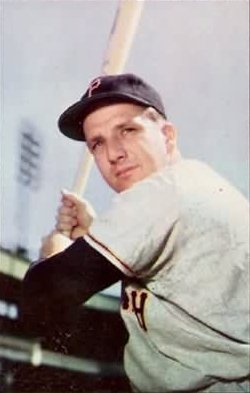
Being a long time Pittsburgher requires absolute loyalty to the Steelers and to the Pirates. I spent 12 years of my life totally and completely addicted to playing baseball. It wasn’t a casual thing; it was total and complete obsession. I was fortunate enough to see and meet many of the greatest baseball players to ever live who played for the Pittsburgh Pirates including Roberto Clemente, Bill Mazeroski, Rocky Nelson, Al McBean, Bill Verdon, Dick Stuart and the list goes on and on. The same year that I was born the Pirates claimed ownership to one of the greatest home run hitters in the game, Ralph Kiner. He was long gone from the Pittsburgh team as I began my early teens, but I followed his career for many years and even copied his batting style. Who doesn’t remember “Kiners Corner”, a shortened area of fence in left-center field at Forbes Field. I’m sorry I never had the opportunity to meet him or to see him play, but he was the ultimate role model for a young baseball crazy kid, and I loved him. Here’s a short bio on Kiner and his truly impressive career.
***
In 1949, Kiner topped his 1947 total with 54 home runs, falling just two short of Hack Wilson’s then-National League record. It was the highest total in the major leagues from 1939 to 1960, and the highest National League total from 1931 to 1997. It made Kiner the first National League player with two 50 plus home run seasons. Kiner also matched his peak of 127 RBI’s. From 1947 to 1951, Kiner topped 40 home runs and 100 RBIs each season. Through 2011 he was one of seven major leaguers to have had at least four 30-HR, 100-RBI seasons in their first five years. Kiner’s string of seasons leading the league in home runs reached seven in 1952, when he hit 37. This also was the last of a record six consecutive seasons in which he led Major League Baseball in home runs.
In 1961, Kiner entered the broadcast booth for the Chicago White Sox. The following year, Kiner, Lindsey Nelson, and Bob Murphy began broadcasting the games of the expansion New York Mets. Kiner also hosted a post-game show known as “Kiner’s Korner” on WOR-TV. Nationally, he helped call the Mets’ appearance in the 1969 and 1973 World Series for NBC Radio. He won a local Emmy Award for his broadcasting work.
Kiner was also known for his occasional malapropisms, usually connected with getting people’s names wrong, such as calling broadcasting partner Tim McCarver as “Tim MacArthur” and calling Gary Carter “Gary Cooper”. Despite a bout with Bell’s palsy, which left him with slightly slurred speech, Kiner continued broadcasting for 53 seasons.
***
Here are a few more for your amusement.
The Hall of Fame ceremonies are on 31st and 32nd of July.
We’ll be back after this word from Manufacturers Hangover. (the correct name was Manufacturers Hanover)
Today is Father’s Day, so to all you fathers out there, we’d like to say, Happy Birthday!
Tony Gwynn was named player of the year for April.
George Shinn is the owner of the Charlotte Harlots basketball team. (the actual name was the Charlotte Hornets)
And finally, I saved the best for last.
Ralph Korner (Kiner introducing himself on his post-game show, Kiner’s Korner”.
Wow, what is it that wonderful smell? I smell NFL football in my immediate future and my Steeler blood lust has taken over. I’m already holding high hopes for a truly successful season this year. I’ve hung my Terrible Towel collection in my man-cave and I’m praying for a gut-busting season similar to the years with Terry Bradshaw, Big Ben Rothlisberger, and the old and hopefully new Steel Curtain. With that in mind, how about some historical football trivia to whet your whistle.
As 1944 opened, the United States was deeply involved in World War II. Of the millions of Americans overseas, many thousands were in North Africa, which had been freed from Axis control during 1943. It happened that several units stationed in North Africa had formed a kind of North African Football Conference. The two top teams in this league wanted to play in an “Arab Bowl.” Other officers and men wanted a game between the Army and the Navy soldiers instead. Finally, a compromise was reached. Why not have a football doubleheader? The first game was to be played by the Casablanca Rab Chasers against the Oman Termites, for the North African Football Conference championship.
On January 1, 1944, it was a very hot day in Oran. In a rugged opening game, that Casablanca Rab Chasers defeated the Oran Termites for the title. And then another problem arose. Neither of these teams would lend their equipment to the teams for the Army-Navy game. Shoulder pads and jerseys were so hard to get at that time and were just too valuable to lend to strangers. It was decided that the second game would be played without equipment, it would be a touch football game between the Army and Navy, and blocking was permitted. Also, they announced the halftime entertainment would be camel and burro races, with members of the Women’s Army Corps and Red Cross nurses mounted on the animals. The selection of the beauty queen was declared a tie between three WAC contestants. Since no one had pads, the ground game was mostly end runs and passes. Nobody was really hurt by the blocking, but the heat caused many substitutions. The Navy scored on a blocked punt and a pass. The kick was good and made the score 7-0. Army tied the game before the half ended. The second half was scoreless until the last minute of the game when Army’s Eddie Herbert intercepted a pass and returned it to the Navy twenty-yard line. With time for one more play the kick split the uprights and Army won the game 10-7.
I’m sure that the men who played in that game remember it more fondly than any Super Bowl they’ve seen since. All that fun without an overpaid celebrity showing boobs or moonwalking during the half-time show.
I decided today to prove once and for all that this blog is fair in the things that it posts. I’m a sports fan when it comes to baseball (Pittsburg Pirates), and I’ve been accused on a couple of occasions that I’m biased towards the teams I like and not so much against the teams I dislike. I know that’s a shock for all of you since none of you would ever do things like that, but I do. Today I’m going to push back a little by telling you a story about one of the Pittsburgh Pirate’s more infamous players and how he earned that reputation. This post is all about Dock Ellis and his famous or infamous no-hitter.
Ellis was, as major league pitchers go, a bit of an odd duck. He wore hair curlers during pregame warm-ups, and according to the baseball records he only stopped when the commissioner of baseball demanded that he do so. In 1974, while pitching against the Cincinnati Reds he hoped to motivate his team by taking aim at the other team’s players – literally. In the first inning alone, he beaned three players (including Pete Rose) before throwing a pitch behind the Hall of Fame catcher Johnny Bench’s head, after which he was promptly removed from the game.
On July 12, 1970, the Pirates had just finished a two-game series in San Francisco and were enroute to San Diego. Since it wasn’t Ellise’s turn to pitch, he spent the day in Los Angeles with some friends, relaxing and dropping acid (LSD). Due to scheduling changes the Pirates had an unscheduled doubleheader in San Diego that afternoon when an extra game was added. Ellis was expected to take the mound and he rushed to catch a shuttle and make it to the ballpark just in time for his game. Through the nine innings he pitched, he struck out six batters, walked eight, but gave up no hits and won 2-0 (a rare and unusual no-hitter). The following quote was later offered up by Ellis in a book where celebrities tell their real-life stories of addiction and recovery. Here’s the quote.
“I can only remember bits and pieces of the game, I was psyched, I had a feeling of euphoria. I was zeroed in on the catcher’s glove, but I didn’t hit the glove too much. I remember hitting a couple of batters, and the bases were loaded two or three times. The ball was small sometimes, the ball was large sometimes, sometimes I saw the catcher, sometimes I didn’t. Sometimes, I tried to stare the batters down and throw while I was looking at them. I started having a crazy idea in the fourth inning that Richard Nixon was the home plate umpire, and once I thought I was pitching a baseball to Jimi Hendrix, who to me was holding a guitar and swinging it over the plate. They say I had about 3 or 4 fielding chances. I remember diving out of the way of the ball I thought was a line drive. I jumped, but the ball wasn’t hit hard and never reached me.”
Dock retired from Major league baseball after the 1979 season and turned over a new leaf. He became a drug addiction counselor and passed away in December of 2008 at the age of 63.
To all of the baseball lovers out there, here’s a little trivia that goes back seventy-two years. It’s nice to know that the tradition of the game remains as frustrating and fascinating as ever.
In baseball there is no clock. A pro basketball game lasts 48 minutes while hockey and football games last 60 minutes. But as the old saying goes, a baseball game (or the inning) isn’t over until the final out. A game on May 21, 1952, between the Cincinnati Reds and the Brooklyn Dodgers proved the old saying true.
The first half-inning had lasted one hour. Twenty-one batters had gotten hits and seven walks, and two batters had been hit by a pitched ball. Fifteen runs had scored, and three men were left on base. The following day the New York Times printed some of the records the Brooklyn team had broken in that that first-half inning:
Most runs scored in one inning (15)
Most runs scored in the first inning (15)
Most runs scored with two outs (12)
Most batters to bat in one inning (21)
Most batters to reach base safely in a row (19)
This last record may be the most amazing of all. Only the first batter and the last had not gotten on base safely. The 19 batters in between had all made it – even the man who was put out on the basepaths for the second out. The Times confessed it couldn’t be sure that 19 batters in a row was a record, but if any major league team ever did better, no one remembers the occasion.
I’ve been a baseball lover my whole life. I have a hard time watching baseball games these days because it’s always been more fun to play than to watch. Thank God for highlights provided on the Internet which makes watching much more pleasant. I was born in the Pittsburgh area and was required to be a rabid Pirates fan by my father and grandfathers. Unfortunately, the team has been a serious disappointment for the last twenty or so years. I still follow the team but not too closely anymore. Maybe that would change if the management of the team ever decides to pry open their fat wallets and spend a little extra money for next level players.
I’m also big into trivia and as I’m surfing the net or reading books, I constantly look for baseball trivia. Fortunately, or unfortunately some of the greatest stories were from the early years of the game before rule changes that made it impossible for players to show much emotion. The current whinny umpires are a tad too sensitive for my liking and really need their moms to show up and hug them. Those nasty baseball players are just soooooooo mean and they apparently hurt the poor umpires’ feelings. Just step-up guys and grow a pair!!! If it’s too upsetting for you – get the hell out of the business. They are one of the reasons that will eventually cause the league to turn over all umpiring duties to computers.
Here are a few trivia facts for you for a taste of baseball at its best.
One of the most popular baseball players of the 1880’s was a catcher-outfielder named Michael Joseph “King” Kelly, who played for Cincinnati, Chicago, New York and Boston. Kelly was a good hitter and a great baserunner. When he tried to steal a base his fans would shout, “Slide, Kelly, Slide!” This phrase was soon printed in the newspapers and made Kelly famous. Kelly was also an alert ballplayer who was always looking for a way to get an advantage over the other team. One day, when he was sitting on the bench, an opposing batter hit a high foul ball that none of Kelly’s teammates would be able to catch. Kelly leaped off the bench and went after the ball. At the same time, he was shouting to the umpire, “Kelly now catching!” Kelly caught the ball, but the umpire refused to allow the catch. “It’s not against the rules,” Kelly declared. “It says in the book that substitutions can be made any time.” The umpire still wouldn’t call the batter out. But Kelly was right. That winter, a new rule was written into the book. Because of Kelly’s alert play, the new rule said that a player could not enter the game while the ball is in play.
On August 13, 1910, the Pittsburgh Pirates played the Brooklyn Dodgers. After nine innings the game was tied, but darkness stopped play. The nine-inning statistics showed that each team had scored 8 runs on 13 hits and committed 2 errors. Both clubs had sent 38 men to the plate, with both sets of fielders credited with 27 put-outs and 12 assists. There were 5 strikeouts recorded against each team, and each side had given up three walks. It was the evenest game ever played.
One day in a Southern League game a batter for Knoxville smashed a long, high fly to center field. Arnie Moser, the centerfielder for Nashville, ran all the way to the scoreboard. The ball was over Moser’s head, and he leaped for it but missed. The ball hit the scoreboard and came down. Moser also hit the scoreboard but did not come down. His belt had caught on a wooden peg, and he was hanging helplessly on the fence, unable to chase the ball and get it back to the infield. Moser’s teammate left-fielder Oris Hockett came racing over to back-up the play. “I’m stuck! Get me down!” yelled Moser. Hockett looked up at his friend, looked for the ball, and looked at the runner rounding second base. He had to make a choice quickly. “Get me down!” yelled Mosier again. “Wait a minute”! hollered Hockett. He picked up the ball and threw it back to the infield to keep the runner from scoring. Only then did he go back to the fence and help get Arnie Moser off the scoreboard peg.
In my younger days I considered myself a scratch golfer. I played with many of my friends, family, and people I worked with for years and always had a great time. I thought today I’d lighten things up a little with some golfing jokes. I’m sure all of you golfers out there will appreciate these three jokes but I can honestly say they can’t compare to the experiences I actually had with my friends and family. Enjoy . . .
One day a man came home from work and was greeted by his wife dressed up in a very sexy nightie. “Tie me up,” she purred, “and you can do anything you want with me.” So, he tied her up and went golfing.
So, there are three golfers, (Bob, Max and Ted) who are looking for a fourth. Bob mentions that his friend George is a pretty good golfer, so they decide to invite him for the following Saturday. “Sure, I’d love to play, says George, but I may be about 10 minutes late, so wait for me.” So, Saturday rolls around. Bob, Max, and Ted arrive promptly at 9 AM and find George already waiting for them. He plays right-handed and beats them all. Quite pleased with their new fourth, they ask him if he’d like to play again the following Saturday. “Yeah, sounds great”, says George. “But I may be about 10 minutes late, so wait for me.” The following Saturday, again, all four golfers, show up on time, but this time George plays left-handed and beats them all. As they’re getting ready to leave, George says, “See you next Saturday, but I may be about 10 minutes late, so wait for me.” Every week, George is right on time and plays great with whichever hand he decides to use and every week, he departs with the same message. After a couple of months, Ted is pretty damn tired of this routine, so he says, “Wait a minute, George. Every week you say you may be about 10 minutes late, but you’re right on time. You then beat us either left-handed or right-handed, what’s the story? “Well,” George says, “I’m kind of superstitious. When I get up in the morning, I look over at my wife. If she’s sleeping on her left side, I play left-handed, and if she’s sleeping on her right side, I play right-handed.” “So, what do you do if she’s sleeping on her back?” “Well . . . That’s one of days I’ll be 10 minutes late.”
A man constantly and continuously talked only about golf. His angry wife threatened to leave him if he didn’t talk about something else. She: “Let’s talk about sex.” He: “I wonder if Tiger Woods got laid last night?”