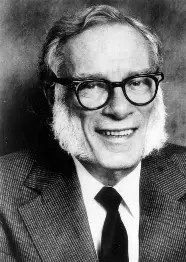
I’ve always been a huge fan of Asimov even before I learned he was a proficient writer of limericks. I’ve been reading his novels for many years and have always considered him to be fellow lover of science fiction. After reading some of his limericks I discovered his relationship with John Ciardi and their famous limerick wars. For those of you not familiar with Azimov and his works I’d recommend you read his greatest work, The Foundation Series. I love reading long and involved stories and I’d put Asimov right up there with J.R.R Tolkien and J. K Rowling. Here’s a few samples of his well constructed limericks.
While primarily known as a poet and translator of Dante’s Divine Comedy, he also wrote several volumes of children’s poetry and contributed to the Saturday Review as a columnist and long-time poetry editor. I could continue with all of his accomplishments but they are endless. In 1981 he co-authored a book, LIMERICKS, with his friend Isaac Asimov. It was called a “War of Words (limericks)” and makes for a great read. Two utterly famous men who absolutely loved writing limericks just for fun.
I pride myself on having a huge and varied collection of limericks as you well know. Most of them are very old with the identity of the writers long forgotten. For the next two weeks I’ll be highlighting some of the more famous limerick writers with samples of their work. Most were well known poets, writers, and authors. Some of their limericks will be off-color and a bit sexual so I recommend that younger children be monitored. Over the next two weeks you’ll be introduced to some of histories best limerick authors. I hope you enjoy them as much as I have.
The first thing I’d like to do is give you a short history lesson on limericks because they’ve been around a lot longer than you might think. The first known limericks appeared in the early 18th century and they just happened to be written in French (and they weren’t called limericks then). Around that same time the Irish Brigade was serving in France (1691 to 1780). The short poems were eventually imported to Limerick, Ireland where their current name originated. Edward Lear 1812-1888, initially wrote many rather mild limericks. It wasn’t until the Victorian Era that the citizenry seized upon the limerick as a way to vent as many four-letter words as possible, much to the delight of young schoolboys. It seems that the bawdiest limericks of that time tended to be written by the British. A few samples of Lear’s tamer limericks will be featured in my next post in two days.
Here is a sample a moderately bawdy limerick of the era:
💥💥❤️💥💥
Said a widow whose singular vice
Was to keep her dead husband on ice,
“It’s been hard since I lost him.
I’ll never defrost him,
Cold comfort, but cheap at the price.”
❤️❤️❤️
My next post will be an introduction to Edward Lear who authored many limericks over many years.
I’ve stated many times as to my love for limericks especially those written by Isaac Asimov. Along with Isaac you must give a shout out to John Ciardi as well. He and Asimov had great fun trying to outdo each other with their written limericks. They even jointly published a book about their limerick feud which is a classic. These four limericks were written by John Ciardi for that book in response to a few that Asimov had written. I’ve read their book many times and still enjoy their bawdy humor. I hope you will enjoy it as well.
💥
The Times tells the world what is doing; Who’s winning, who’s losing, who’s suing, Whose striking, who’s stealing, Who’s dying, whose healing, But won’t say a word on who’s screwing.
💥💥
The girl who is really unbeatable Is the one with whom sex is repeatable. Who’s eternally screwable And always renewable, And who, most of all, is found eatable.
💥💥💥
There was a young woman named Cora Lee Who said, “I will do it immorally On top and bottom, Any way that I’ve got them, Vaginally, anally, and orally”.
💥💥💥💥
There once was a wicked old squire Who burned with libidinous desire. After screwing a nun And the minister son, He took all the girls in the choir.
📕📕📕
THE BOOK IS TITLED – ISAAC ASIMOV & JOHN CIARDI – A WAR OF WORDS
Abraham Lincoln lost five different elections prior to becoming a United States president.
There are 13 letters in the Hawaiian alphabet.
The only word that begins and ends with the letters “und” is the word underground.
Due to contrasting gravity, a person normally weighing 200 pounds on earth will weigh just 76 pounds on Mars.
Recycling one glass jar will save enough energy for three hours of television.
A tsunami can move at the same speed as a jet plane.
You could fit almost 900,000,000,000,000 footballs into the Grand Canyon.
Rio de Janeiro means River of January.
Sometimes when you are sleeping, your brain is busier than when you’re awake.
The left and right sides of your body are controlled by the opposite sides of your brain.
In Japan you can buy square watermelons, specifically created to stack more easily in supermarkets.
Wild lions usually do not kill more than 20 times a year.
Crocodiles along the banks of the Nile River are accountable for over 1000 deaths per year.
🤖🤖🤖
And last but not least some information that I hope our
current generation of scientists are paying attention to.
1. The First Law of robotics is a robot may not injure a human being or, through inaction, allow a human being to come to harm.
2. The Second Law of robotics is that a robot must obey any orders given to it by human beings, except where such orders would conflict with the First Law.
3. The Third Law of robotics is that a robot must protect its own existence as long as such protection does not conflict with the First or Second Laws.
I’ve made it clear over the years that I’m a huge fan of Isaac Asimov. I’ve tried to read as many of his writings as I could find, and his limericks are outstandingly bawdy. He also has another talent which I really appreciate and that was his ability to collect odd facts. It never ceases to amaze me how diverse his level of knowledge became over the years, and it still fascinates me. It was one of my motivations for starting this blog because there are just so many interesting odd and weird facts available and most of them never see the light of day. This blog is my way of bringing as many of those facts as possible to light so you all can enjoy them. Today’s topic of discussion will be the world of entertainment. Where else could you find the appropriate amount of weirdness that Asimov so religiously documented. Here we go.
Not until 1959 was a play by a black woman produced on Broadway. 29-year-old Lorraine Hansberry’s starred in, A Raisin in the Sun, which concerned the problems (comic and serious) of a black family in modern day America. It was highly successful and eventually made into a motion picture.
The great French actress Sarah Bernhardt was obsessed with death. As a teenager, she made frequent visits to the Paris morgue to look at corpses of derelicts dragged up from the Seine, and she begged her mother to buy her a pretty rosewood coffin with white satin lining. The coffin became part of the Bernhardt legend. Occasionally, she slept in it, and eventually she was buried in it when she died at the age of 79.
A U.S. television network’s dramatic representation of the trial of Nazi judges was sponsored by the natural gas industry. The word “gas” was excised from the script, but a few “gases” slipped by the censors; those had to be blipped before the program was aired.
During the pre-Broadway tour of the 1936 musical Red, Hot and Blue, Cole Porter had to do a lot of rewriting. Rather than hire a professional stenographer to take his dictations and transcribe the changes, he used the services of one of the stars of the show, Ethel Merman. Before she went into show business, Ms. Merman had been a secretary. Porter described her as “among the best stenographers I’ve ever had.”
A tambourinelike instrument used in old time minstrel shows was made from the jawbone of a horse or ass, from which the instrument got its name, “Bones.” When the bone was thoroughly dried, the teeth were so loose they rattled and produced sounds as loud as a castanet. Every minstrel troupe had a “Mr. Bones.”
Rin Tin Tin, for years the most famous dog in the world, was born to a war-dog mother in a German trench in France during World War I. Deserted when the Germans retreated, the German-shepherd puppy was found by an American officer who just happened to be a police dog-trainer from California. He trained Rin Tin Tin when they returned home. The dog was so intelligent he came to the notice of Warner Brothers Studios, which signed him up for what turned out to be a long career as one of the biggest box office draws of the silent screen era.
I just love these hidden stories and facts and envy Azimov’s ability to research and publish all of them. I’m happy to share them with you and I hope you enjoyed them.
No matter what day of the week or month of the year, there’s always time for some of Mr. Asimov’s finely crafted limericks. These will tend to be a bit more off-color than the ones I usually post so keep your kids and prudish spouses clear. This is a really good way to kick off your week. Here we go . . .








 everyuselessthing.com