I’m a lover of quotations as you all know. Some are poignant and other are a bit to smarmy and silly. They’re all good if you take them at face value. Just don’t read too much into them or your in trouble. I’ve collected many that are funny and those are my favorites regardless of who supplied them. These following sayings are from all sorts of people, some well known but most are not. Here they are . . .
The devils boots don’t creak. Scottish Proverb
Losing weight is a triumph of mind over platter. Anon
Nothing is more dangerous than a friend without discretion; even a prudent enemy is preferable. Jean de la Fontaine
It is easier to know how to do than it is to do. Chinese Proverb
When dealing with people remember you are not dealing with creatures of logic, but with creatures of emotion, creatures bristling with prejudice, and motivated by pride and vanity. Dale Carnegie
Speak well of your enemies, sir, you made them. Oren Arnold
God is a father; luck, a stepfather. Yiddish Proverb
A graceful taunt is worth a thousand insults. Louis Nizer
My lawyer was hurt – the ambulance backed up suddenly. Anon
A leader is best when people barely know he exists. When his work is done, his aim fulfilled, they will all say, “We did it ourselves.” Lao-tzu
I’m always good for more limericks and today’s offering is from one of my favs, John Ciardi. I’ve been a huge fan of his limericks since reading the book he shared with Issac Azimov. Two crazy smart limerick aficionados.
Are you an avid reader? I’ve been one since a very early age and it will continue forever. One of my favorite reads is just about anything ever written by Isaac Azimov. He was a prolific writer as well as a noted intellectual. His areas of interest were many but today I’ll post a few facts he gathered concerning books since we’ve both shared a love for them. Books are great and history is even greater. How can I go wrong posting about the history of books?
Columbus had with him on his first voyage to the New World a copy of Marco Polo’s book about his 13th century, twenty-two-year odyssey to China and back.
Twice as many books on religion were published in England as works of fiction in 1870. Sixteen years later, novels far outnumbered religious works.
The Library of Congress houses over 72 million pieces of research material, including over 16.5 million books and 31 million manuscripts, and costs over $150 million a year to run.
The Communist Manifesto of Marx and Engels was ignored in Germany when it was published in 1848, and a Russian translation was suppressed by censors in the 1860’s. It remained a rare pamphlet until it was reprinted in 1872.
The art of printing from wooden blocks with the characters in reverse was initiated in Buddhist monasteries in China. The oldest surviving printed book that can be reliably dated is a Buddhist text, the Diamond Sutra, made in China in 868 A.D.
Euclid is the most successful textbook writer of all time. His book Elements dated around 300 B.C. has gone through more than 1000 editions since the invention of printing.
General Lew Wallace’s bestseller Ben Hur was published in 1880 and was the first work of fiction to be blessed by a Pope.
America’s first best-selling novelist was a woman, Susanna Haswell Rowson. Although it was a melodramatic work with wooden characters and a hackneyed plot, Charlotte Temple, published in 1791, appealed to popular tastes. It went through more than 200 editions.
Icelanders read more books per capita than any other people in the world.
To get her book published, in 1896, Fannie Farmer had to pay publishers Little, Brown and Company the printing costs for the first 3000 copies. The publisher refused to take the risk, saying that women would not buy still another collection of recipes. Ironically, her Boston Cooking School Cook Book eventually became the most popular cookbook of its time and a “gold mine” through the years for the publisher; millions of copies have been sold in dozens of editions.
It amazes me just how fast this year has flown by. It won’t be long here in Maine until I’m whining and complaining about the snow. Thinking about snow and ice is depressing most of the time but I’ll deal with it by writing about things that make me less depressed and bored. Being a formal high school and college graduate, I found the following statements to be funny and sad. Funny because some are ridiculous and sad because they’re all taken from actual high school and college exams. This collection mostly concerns Music Appreciation ad Music History.
A virtuoso is a musician with real high morals.
A harp is a nude piano.
The principal singer of 19th-century opera was called the pre-Madonna.
An interval in music is the distance between one piano to the next.
Agnus Dei was a woman composer famous for her church music.
A tuba is much larger than its name.
When electric currents go through them, guitars start making sounds. So would anybody.
I can’t reach the brakes on this piano.
The most dangerous part about playing cymbals is near the nose.
The correct way to find a key to a piece of music is to use a pitchfork.
As much as I love bawdy limericks, I also love those written by the kids for other kids. And it’s also nice to know that another generation of limerick lovers and writers are waiting in the wings.
It’s not often I get surprised especially by anonymous gifts from readers. My surprise occurred a few days ago when I received a fifty-page paperback booklet printed in 1999. It contains a collection of what are titled “Looney Limericks”. I haven’t the faintest idea who sent it but please consider this a big thank you, whoever you are. Here are a few samples of some clean and funny limericks apparently written for children.
Here are the final limericks in Mr. McCord’s limerick construction primer. I thoroughly enjoy reading the work created by such an intelligent man who enjoys his love of poems and limericks as I do. His non-limerick poetry is also outstanding as you will see.
💥💥💥
It’s been a bad year for the moles
Who live just in stockings with holes;
And bad for the mice
Who prefer their boiled rice
Seved in shoes that don’t have any soles.
💥💥💥
There once was a man in the Moon,
But he got there a little too soon.
Some others came later
And fell down a crater,
When was it? Next August? Last June?
💥💥💥
I don’t much exactly quite care
For those cats with short ears and long hair.
But if anything’s worse
It’s the very reverse:
Just you ask any mouse anywhere.
💥💥💥
💥💥💥
So, by chance it may be you’ve not heard
Of a small sort of queer silent bird.
Not a song, trill, or note
Ever comes from his throat.
If it does, I take back every word.
💥💥💥
And last but not least.
Write a limerick now. Say there was
An old man of some place, what he does,
Or perhaps what he doesn’t,
Or isn’t or wasn’t.
Want help with it? Give me a buzz.
💥💥💥
I heard my first limerick when I was about 7 years old when I was eavesdropping on my father and one of his friends. I heard my dad recite this little gem. My love of limericks was born!
As promised, here is the second installment of David McCord’s limerick writing primer. He not only shows how to write a limerick but gives excellent examples of the various types you can create.
I’m going to introduce you today to a man who was famous for writing limericks, Mr. David McCord. He was also a philanthropist, writer, and poet who held honorary degrees from 22 universities. He was famous for his work in teaching children to write poetry. This first limerick is a short instruction on who to structure a limerick.
David McCord
The limerick’s lively to write:
Five lines to it – all nice and tight.
Two long ones, two trick
Little short ones, then quick
As a flash here’s the last one in sight.
There are 13 limericks published over fifty years ago and were Mr. McCord’s attempt to explain and teach how to write a limerick. Here are the first four. I’ll post a few each day until the entire collection is in your hands. Maybe they will encourage you to write a few of your own.
There once was a scarecrow named Joel
Who couldn’t scare crows, save his soul.
But the crows put the scare
Into Joel. He’s not there
Anymore. That’s his hat on the pole.
💥💥💥
“There was an old man” of wherever
You like, thus the limerick never
Accounts for the young:
You will find him unsung
Whether stupid, wise, foolish, or clever.
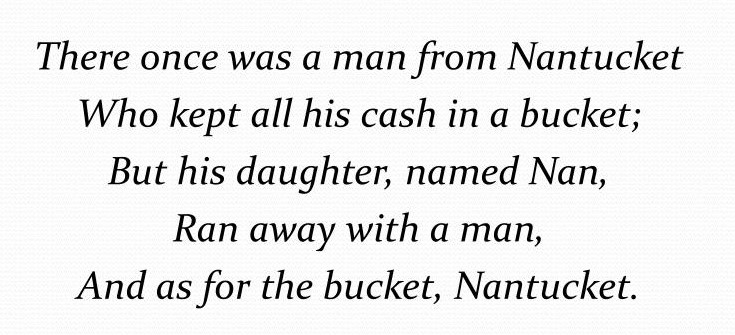
A Rare Non-Dirty Nantucket Limerick
There was a young man let me say,
Of West Pumpkinville, Maine, USA.
You tell me there’s not
Such a place? Thanks a lot.
I forget what he did anyway.
💥💥💥
Take the curious case of Tom Pettigrew
And Hetty, his sister. When Hettigrew
As tall as a tree
She came just to Tom’s knee.
And did Tom keep on growing? You bettigrew.
That’s lesson number one for today. If you read them carefully, he gives excellent rhyming tips and how exactly to structure the limerick. More to follow tomorrow.











 everyuselessthing.com