I just thought today would be a good day to congratulate the Philadelphia Eagles for one of the greatest games I’ve ever had the pleasure of watching in recent years. I’m a dyed-in-the-wool Steelers fan and I’m supposed to hate the Eagles no matter what. The hell with that, they looked unbelievable and unbeatable. The cherry on top of the game was Saquon Barkley becoming the greatest running back in the NFL. No true sports fan can ask for more than that. I won’t even mention all of the ridiculous half-time hip-hop BS because it was an insult to America. I don’t understand why we still wonder why the rest of the world has such a low opinion of us. I’ll end this rant on sports by offering many kudos to the Philadelphia team along with a friendly warning; the Steelers will be back next year and hopefully they’ll remember how it feels to be the reigning champs and play accordingly.
Today’s post is something that’s apparently popular to my readers because every time I post a quiz the responses have been excellent. As anyone that reads this blog knows I’m not a religious person, but today’s quiz is going to test your knowledge about religion. I’m not claiming to have all these answers, but I’ll bet you don’t either. As always, the answers will be shown at the bottom of the post.
Who was the only Englishman to become Pope?
How tall was Goliath, the Philistine giant slain by David with a stone hurled from a sling?
What language is Jesus believed to have spoken?
What was the first town in the United States to be given a Biblical name?
What does the word “amen” really mean?
According to the Bible, how many pearly gates are there?
According to the Bible, on what day did God divide land and water?
How many people were on Noah’s Ark?
How high were the walls of Jericho before they came tumbling down?
In what language was the New Testament originally written?
ANSWERS
Nicholas Breakspear who was Pope Adrian IV, “Six cubits and a span” or 11’9″, Aramaic, Salem-Massachusetts, “So be it”, 12, On the third day, 8, 21 ft, Greek
We woke up to five inches of snow this AM. I was forced into snow-blowing the driveway at 7:15. I’m really glad I didn’t wait because the snow was slowly melting and getting heavy making the snow-blower work extra hard. The driveway is now clear making it possible for my shopaholic better-half to get out and about. I really haven’t decided what to post today so taking a tip from some of my teachers of years ago, when in doubt they just gave us a pop quiz. Since food always seems to interest everyone, here are ten questions for you foodies out there. The answers will be listed below.
What animal is the source of milk used in making Roquefort cheese?
What part of the banana is used to make banana oil?
Two states have official beverages. Florida is orange juice, what is the other?
What words are found on the three rings of the Ballentine beer label?
How many quarts of milk does it take to make one pound of butter?
How much money did American Airlines claim to have saved in 1987 by eliminating one olive from each of it’s salads served in the first-class sections?
What fruit did the Visigoths demand in ransom when they laid siege of Rome?
What is the BRAT diet to eliminate diarrhea?
What do Eskimos use to prevent their food from freezing?
If you ordered the Five B’s breakfast in New England, what will you be served?
Answers
The Ewe (female sheep), None-banana oil is a synthetic, Ohio-tomato juice, Purity-Body-Flavor, 9.86 quarts, $40,000.00, 3,000 lbs. of peppercorns, Bananas-Rice-Applesauce-Toast, Refrigerators, Boston Baked Beans and Brown Bread
For many years I’ve considered myself a true “foodie”. I’ve always made a point to try damn near anything called food. Of course, that has changed dramatically as I’ve aged. Truthfully, I don’t really miss my entrees of “dog soup” and “cat spring rolls” I once tried in Korea. So, when I started collecting odd facts and trivia, food always seems to be mentioned in some fashion. Here are a few little-known facts about food I’ve collected. How many have your heard before?
What is the name of the dog on the Cracker Jack box? Bingo.
What is the American name for the British delicacy known as trotters? Pig’s feet.
Under US government regulations, what percentage of peanut butter has to be peanuts? 90%.
Who originally coined the phrase that has been appropriated as the slogan for Maxwell House coffee; “Good to the last drop”? President Theodore Roosevelt
What recipe did Texas ice cream maker Elmer Doolin buy for a $100 from the owner of a San Antonio café in 1933 and later used to make a fortune? The recipe for tasty corn chips that was later marketed as Fritos. He made them at night in his mother’s kitchen and peddled them from his Model-T Ford.
A California winemaker from Napa Valley once named a wine in honor of Marilyn Monroe. What was it called? Marilyn Merlot.
What food product was discovered because of a long camel ride? Cottage cheese. An Arab trader found that milk he was carrying in a goatskin bag had turned into a tasty solid white curd.
Peter Cooper, best known for inventing the locomotive “Tom Thumb”, patented a dessert in 1845. What was it? A gelatin treat that eventually became known as Jell-O when it was marketed in 1897.
In 1867 Emperor Napoleon III had a chemist develop a food product “for the army, navy, and the needy classes of the population.” What was it? Margarine.
What was the drink we know as the Bloody Mary originally called? The Red Snapper, which was it’s name when it crossed the Atlantic from Harry’s New York Bar in Paris.
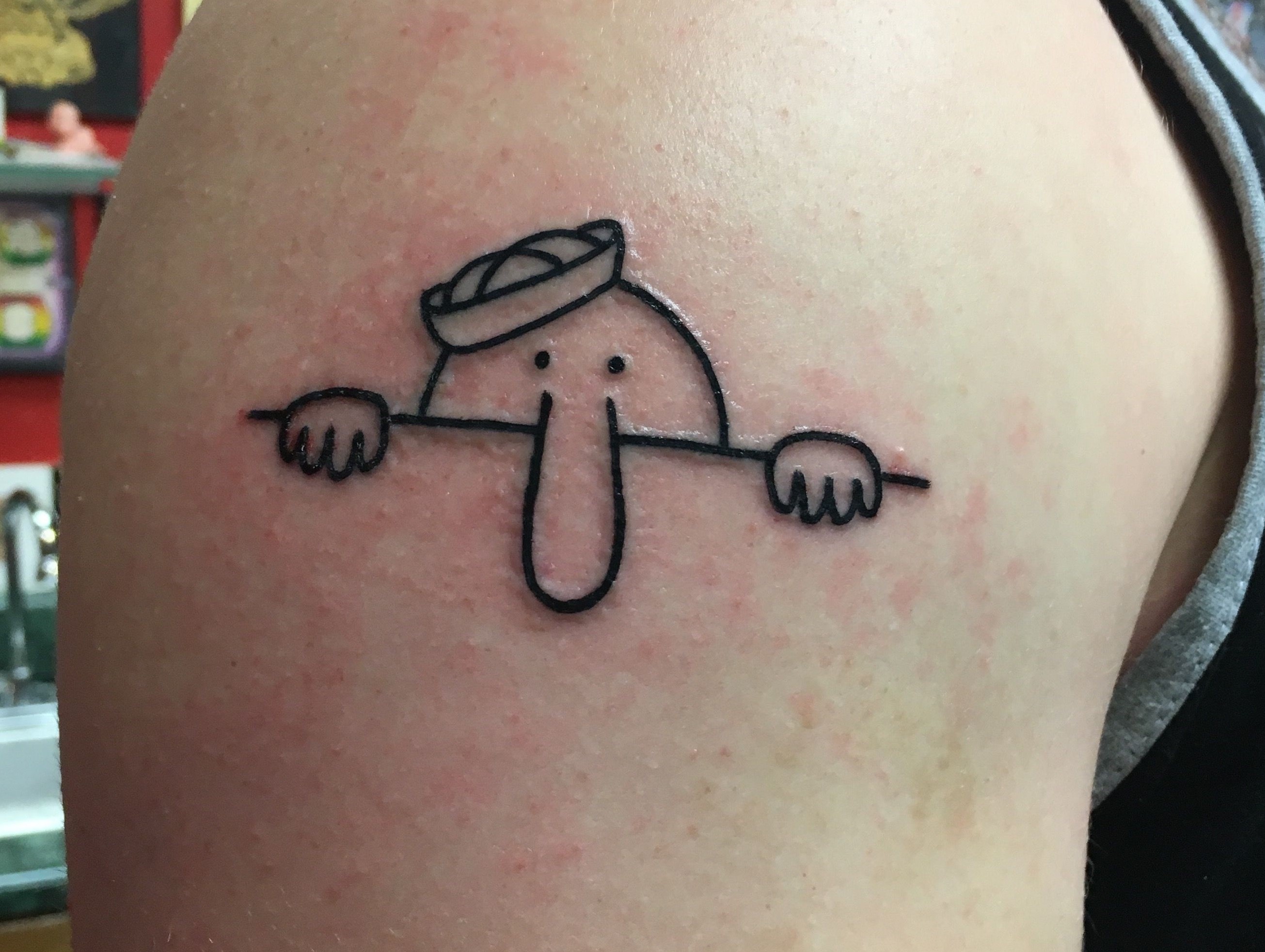
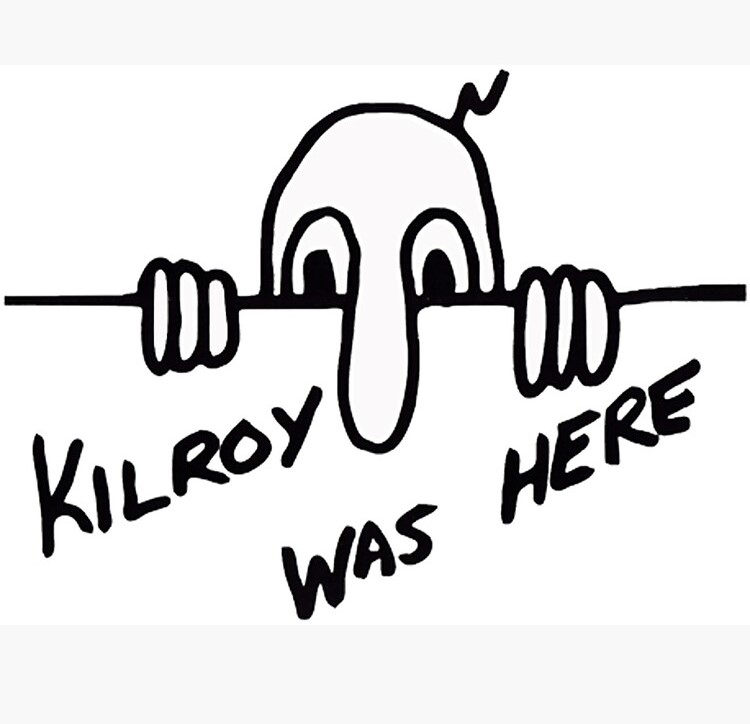
I’m reasonably sure that most of us are familiar with the saying “Kilroy was here.” I’m also sure that most of us (especially non-military folk) haven’t a clue where it came from and how it’s managed to survive since its creation early in World War II. Here’s part of that story . . .
The exact creation of this image has never been discovered. It began appearing early in World War II and was found on ships, railroad cars, bunkers, fences, the occasional fighter plane, bombs, and the occasional torpedo.
In 1946, just after the war ended, the American Transit Association began a search for the real Kilroy and offered a real trolley car as the prize. Approximately 40 men tried to claim the prize, which was eventually awarded to 46-year-old James J. Kilroy of Halifax, Massachusetts. The judges thought that his story was the most convincing. During the war, Kilroy was an inspector at the Bethlehem Steel shipyard in Quincy, Massachusetts, that produced ships for the military effort. Kilroy discovered that he was being asked to inspect the same ship bottoms and tanks again and again, so he devised a way to keep track of his work. He used a yellow crayon and wrote “Kilroy was here.” in big block letters on the hatches and surfaces of the ships he inspected. The same ships then made their way overseas with Kilroy’s inscriptions intact. Also, over the course of the war, 14,000 shipyard employees also enlisted, most of whom went overseas as well. No one knows who first decided to imitate the crayon scrawled words, but before long, soldiers saw them everywhere. It became common practice for the first soldier into a new area to pull out a piece of chalk and let those behind him know that Kilroy had already been there too.
True or not James J. Kilroy story convinced the judges and won the contest. What did he do with the trolley car? Kilroy had a big family, so he attached a 50 foot long, 12-ton trolley car to his house and used it as a bedroom for six of his nine children.
Just as an aside, I can’t tell you how many times when I was in the Army both here in the US and overseas, I discovered very quickly that “Kilroy was (already) here.” It was scrawled everywhere. Once while in Korea I was climbing through a deserted gun emplacement in the hills near Inchon. There was old graffiti on the walls from some Turkish soldiers which I couldn’t read and right next to them was a huge “Kilroy was here!” Most recently and most poignant was this magazine photo taken at the home of Osama bin Laden just after his capture.
TRUTHFULLY, I CONFESS TO PLACING “KILROY” ON A FEW THINGS MYSELF.
Today’s post is going to do the unimaginable and permit us to time travel back 84 years to 1940. This is going to be a rambling narrative of things that were happening at the time and will start with the top five movies of the day: Boom Town, Fantasia, His Girl Friday, Kitty Foyle, and Knute Rockne All-American. Strange as it seems I recently saw a couple of these movies being streamed and I spent an hour and a half watching His Girl Friday with Cary Grant. After all those years it was still fun to watch because Cary Grant was effing amazing.
Ginger Rogers earned the best actress at the Academy Awards. The movie Grapes of Wrath was huge, and Walt Disney’s animation began to become a force in the movie industry with Pinocchio and Fantasia. Tom and Jerry weren’t far behind with Hanna-Barbera releasing Puss Gets the Boot. The year also brought us two future celebrities: Smokey Robinson born on February 19 and Peter Fonda born February 23. With the Great Depression over, 1940 consumer food intake became more dependent on canned foods such as soup, meat and vegetables.
Air travel was on the rise and the NFL’s Green Bay Packers became the first team to travel by air. The TWA Transcontinental Airline introduced the Stratoliner to help promote more travel across the continent. The United States had yet to be drawn into the war in Europe. The 1939-1940 World’s Fair was held at Flushing Meadows-Corona Park in New York and was the largest world’s fair of all time.
In the world of sports baseball rapidly was spreading in popularity across the country. The Negro National League was steadily becoming more popular with teams like the Washington Homestead Grays (league champs), the Baltimore Elite Giants, and the Newark Eagles playing to large crowds.
Knute Rockne ruled college football with the University of Minnesota Golden Gophers being named the national champs. The Heisman Trophy winner was Michigan halfback Tom Harmon. The NFL Chicago Bears defeated the Washington Redskins 73-0, in one of the most one-sided games in professional football history.
In the early 1940’s cars began to take on a lower, longer and broader look. This new look fit in well with the luxury cars that were beginning to be produced. They were the La Salle Series 52, the Lincoln Zephyr V-12, and the Packard Custom Super-8 180.The Pennsylvania Turnpike was opened on October 1, 1940, and the first Los Angeles freeway was dedicated in December.
The entertainment industry released the top hits of 1940: In the Mood-Glenn Miller, Frensi-Arte Shaw, Only Forever-Bing Crosby, and I’ll Never Smile Again-Tommy Dorsey. The talk radio shows of 1940 listed The Adventures of Ellery Queen, Edgar Bergen and Charlie McCarthy, and Fibber McGee and Molly. And last but not least Franklin Delano Roosevelt hit the campaign trail in an attempt for a third term.
Now for some of the important stuff. The US population was 132 million. The average salary for a full-time employee was $1200 a year with the minimum wage of $.30 an hour. A loaf of bread was $.08, a pound of bacon was $.27, a pound of butter was $.36, a dozen eggs were $.33, a gallon of milk was $.26, a pound of coffee which $.21, 5 pounds of sugar was $.26, 10 pounds of potatoes was $.24, gasoline was $.11 a gallon, movie tickets were $.24, postage stamps were $.03, and an average car cost $990.00, and a single-family home was on average $2938.00.
I thought today would be a good day to post some poetry by youngsters. I’ve read all of the most famous poets, but they don’t give me the same kind of rush that poetry by younger people gives me. These were obtained from various English-speaking countries around the world. I hope you enjoy them as much as I have.
✍🏻
THE GRASS by Warren Cardwell, age 8, United States
The grass seems to dance,
It seems to walk,
It seems to talk,
It seems to like to
Have you walk on it,
And play with it too,
It seems to be stronger than you or I.
✍🏻✍🏻
THE JELLYFISH by Glenn Davis, age 11, Canada
Dome-like top, speckled, comets converging.
Gold-green flesh, wave edges urging.
Jellylike globules, soft lattice arms,
Spiked fury, leather lash meting out harm.
Golden-smooth rods, waving whiplike with water,
Beauty and danger, the jellyfish slaughter.
✍🏻✍🏻✍🏻
DEW ON A SPIDER WEB by Michael Capstone, age 10, New Zealand
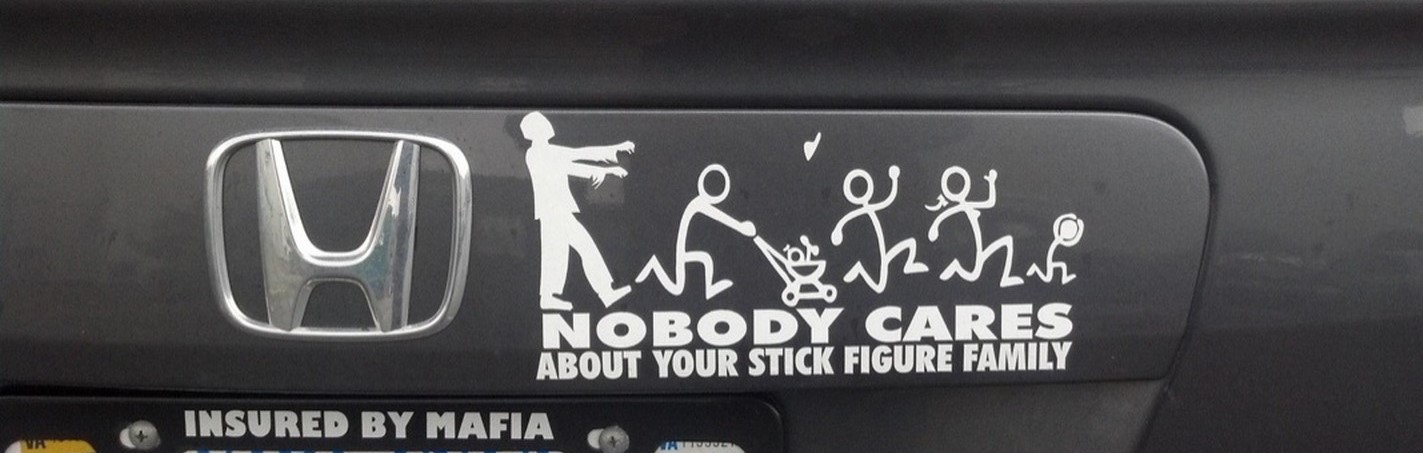
I went out early this morning to do a little food shopping and I noticed something that’s been bugging me for a while now. It seems to me that people these days are just criminally boring. One of the few pleasures that I’ve had over the years has been locating and reading funny bumper stickers. Those types of bumper stickers are damn hard to find anymore and I’m not sure why. I guess we can thank the WOKE generation for all of those good influences (that was sarcasm). The only thing you see these days are decals on their rear windows telling the entire world how many kids they have, what pets they have, what sports they like, and what schools they attend. It’s like a shopping list for perverts and pedophiles.
One of my favorite things when I purchased a new car was to always find just the right bumper sticker. Many years ago, I purchased a cute little orange Gremlin. It was a cool little car, and I immediately chose an appropriate bumper sticker that said, “Honk If Your Horny.” I received lots of comments from a variety of people and it was always good for a chuckle or two. I once loaned that car to my sixty-five-year-old very Catholic mother for her weekend shopping trip to Pittsburgh. When she got home, she couldn’t wait to tell me how friendly the people in Pittsburgh were because they were honking and waving to her wherever she went. I didn’t have the heart to tell her about the bumper sticker, but she eventually found out. Funny, she never asked to borrow that car again.
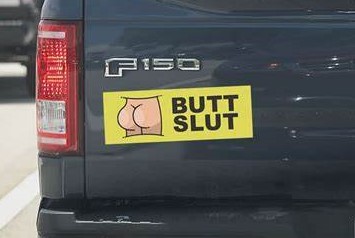
I just never see those interesting kind of bumper stickers anymore. Here are a few samples of bumper stickers that are still out there but they’re few and far between. Most drivers these days are deathly afraid of offending someone. So, with that being said, here are a few you might enjoy but be careful about who you show them to, they might get offended.
I’m looking for true love, but I’ll settle for cheap sex.
Ask me if I care.
Good girls go to heaven. Bad girls go everywhere.
Love is a four-letter word.
If your phone doesn’t ring, it’s me.
See Dick drink. See Dick drive. See Dick die. Don’t be a dead Dick.
Nobody’s ugly after 2 A.M.
Fight Crime. Shoot Back.
Ask me. I might.
It is as bad as you think, and yes, they are out to get you.
I think today I’ll keep this post rather short. I’m actually celebrating the fact that after two and half days of having no electric, no Internet, no phone service, and just generally cold and crappy weather, the storm has ended, and things are beginning to normalize. This ice storm destroyed most of southern Maine by damaging trees, adjacent homes, and dangerous conditions for any traveling. We have trees down everywhere and there’s still a few hundred thousand people in Maine with no power. I guess I got lucky that my street was repaired only after we sat in the dark and cold for two days. This is the second such storm in as many months totaling eight solid days of no utilities Internet, power, etc. etc. etc. It just brings home the fact that we rely on technology for damn near everything. Unfortunately, it’s also the first thing to fail.
I’ll probably be spending a great deal of time in the next few days trying to clean up the property because in my backyard alone I have three trees down and they have to be removed. I know that sounds bad but compared to most of the neighbors in this area I got off with minor damage. I thought I had all of the contingencies covered with storm preparation by installing a generator to carry the load when the electric goes out. Unfortunately, when the generator was supposed to kick in and turn on the electric it failed to work. Trying to find service people during a storm crisis is ridiculously difficult but I did get lucky. I made one call requiring that I travel 2 miles from my house, stand on my car roof and wave my hands in the air to get a signal in the midst of all this chaos. I guess I have to believe in miracles because within a half an hour of making that call, I returned home to find the electrician, his son, and a truck load of parts in my driveway. They dismantled my generator and immediately corrected the problem. As I write this, I’m still amazed. Things like that almost never happen but I’m certainly glad they did.
After all of that aggravation the power was fully restored this morning and now the cleanup begins. I hope and pray there are no more surprise spring storms showing up. Nothing good comes of these storms except if you own a Home Depot or Lowe’s, then you’re making a damn fortune. More to come in the next day or so and hopefully I can get this blog back to normal by then. Meanwhile . . . .
As all of you should be aware, I am a lover of history. Not just that run-of-the-mill American history that everybody knows about and has read about in textbooks. I like quirky, odd, and obscure stories of American history. Here are a few samples of some historical notes about the United States that the majority of you never heard of.
The United States has profited greatly twice at the hands of a nation that viewed Great Britain as their enemy. In 1803, France, aware it could not hang on to the vast Louisiana Territory, sold it to the United States for 2 1/2 cents per acre rather than have it fall into Great Britain’s hands. In 1867, Russia sold the 586,400 square miles of Alaska to the United States for less than two cents an acre. The logical purchaser would have been Great Britain, whose minions in Canada bordered the land on the East, but Russia considered Great Britain to be an enemy (Britain had won the Crimean War against the Russians and sided with the Confederacy in the United States Civil War).
The Pony Express, which has lived in legend for more than a century, lived in fact for less than two years. Indian raids curtailed service on the 1966-mile route between St. Joseph, Missouri, and Sacramento, California. The transcontinental telegraph finally replaced it in late 1861.
In 1813, Major George Armistead, command of Fort McHenry, placed an order for a flag “so large that the British would have no difficulty in seeing it from a distance.” In fulfilling the commission for that flag, subsequently celebrated as “Old Glory” and “The Star-spangled Banner,” Mary Pickersgill and members of her family sewed over 400 yards of bunting into a banner 30′ x 42′, costing $405.90. This was the flag that Francis Scott Key saw that “was still there.” It hangs today in the Smithsonian Institution.
The American Colonization Society was formed, in 1816, by the Rev. Robert Finley of New Jersey, for the purpose of establishing an Africa colony to which the 200,000 U.S. blacks freed by slaveholders or born to free parents could be sent. Prominent slaveholders like Calhoun, Clay, Randolph, and Jackson supported the Society because they feared the threat to slavery posed by free blacks. Congress was persuaded to lend aid for land purchases. In all, about 15,000 blacks left America for the colony, which came to be called Liberia. The capital is named Monrovia, for President James Monroe.
The first nation to receive foreign aid from the United States was Venezuela. In 1812, Venezuela, fighting for its independence from Spain, suffered a severe and damaging earthquake. Congress appropriated $50,000 to help the victims.
Eskimos use refrigerators to keep food from freezing.
I wish I could live seventy-five more years and then be able to read a blog similar to this explaining to the citizens of that time how weird, stupid and crazy we were. It would probably be worth a million laughs to those future citizens. The Clinton years alone could supply enough weirdness laughter and gagging for many blog postings.
Well, it’s Sunday and the Steeler game has been canceled until Monday due to weather concerns. It’s a little annoying but not all that surprising for anyone who’s ever been in Buffalo during the winter. In my previous life as a regional manager for a national chain I was assigned stores in Buffalo and Niagara Falls. I swear to God that every time I made a trip there during the winter, I ended up getting snowed in and spending an extra day or two in order to give the citizens time to clean up the snow, open the roads, and allow me to fly the hell out of there. Buffalo is a nice town (sarcasm) but not a place I’d like to spend any extra time in. I’ve been to Niagara Falls and unfortunately if you’ve seen one waterfall you’ve seen them all. With that being said and since my day has been interrupted, I thought I’d get a little silly. Everyone seems to love the limericks I post so I offer you a few odd ball limericks today. These are tongue twister limericks written by a gentleman named Lou Brooks in 2009 in a book of the same name. Enjoy . . .
❄️❄️❄️
Nosy Rose got closed in a closet of clothes,
The clothes closet closed on Rose’s red rosy nose,
She tweaked on her beak,
For over a week,
Rose’s nosy red nose now hangs close to her toes.
🌨️🌨️🌨️
Walt walked and talked on his wife’s walkie-talkie,
Walt’s wife’s walkie-talkie made Walt’s talky-talk squawky.
Wide awake while Walt walked,
Was what Walt was while he talked,
While Walt’s wife walked her way to Milwaukee.
Two of these should be sufficient. Trying to get a computer program to type these as I speak is ridiculous. Here’s a description of my day in a nutshell.















 everyuselessthing.com