I’ve spent a few nights recently getting reacquainted with Isaac Azimov’s Foundation series. It’s a classic creation that I’ve read a number of times over the years and it’s still a great read. Being a huge fan of Azimov I still read the story in absolute amazement much like I get when I read the writings of J.R.R. Tolkien. How their minds work to write these amazing stories puzzles me but I still enjoy every minute spent reading them. Todays post will contain a group of unrelated facts collected by Azimov over the years and I thought you might enjoy them.
After the most recent North American glacier ended its southward advance about 11,000 years ago, it took more than 4,000 years for the mile-deep ice mass to melt from the present site of Hartford, Connecticut to that of St. John’s, Vermont, a distance of 190 miles.
The Earth receives only one-half of one-billionth of the sun’s radiant energy. But in just a few days it gets as much heat and light as could be produced by burning all of the oil, coal, and wood on this planet.
The first English settlement in what became New England was founded 13 years before the arrival of the Pilgrim’s. In 1607, a settlement was established at Popham Beach, Maine. After a year, its inhabitants found the climate too harsh, and departed.
During most of the Middle Ages, few people, including kings and emperors, were able to read or write. The clergy were virtually the only ones who possessed those skills.
Blue Laws became known as such because of the color of the paper on which they were printed. In 1665, Theophilus Eaton, governor of the New Haven Colony, and a friend, clergyman John Davenport, drew up the strict legal code regulating personal conduct that subsequently became known as the Blue Laws.
Dr. Samuel A. Mudd, was sentenced to life in prison for splinting the fractured leg of Abraham Lincoln’s assassin, John Wilkes Booth, became a hero to guards and inmates of his island prison when he stopped a yellow-fever epidemic there, in 1868, after all of the Army doctors had died. President. Johnson, Lincoln’s successor, pardoned Mudd in early 1869.
Until the “pooper-scooper law” was passed in 1978, the 500,000 dogs in New York City deposited 175 pounds of fecal matter on the streets each day. The law requires dog owners to clean up after their dogs, on penalty of fines up to $100. Most dog owners comply, and New York City is much cleaner.
President Lincoln’s only son to live to manhood – Robert Todd Lincoln – was at hand at the assassinations of three Presidents: his father’s, Garfield’s, and McKinley. He was called to the house where his father was dying; arrived only moments after Garfield was shot in the capital and McKinley was shot in Buffalo.
As you are all aware collecting strange facts and stories is my life. It was also a hobby of one of my favorite writers, Isaac Asimov. I’ve mentioned him many times through the years because he was not only a prolific writer but a huge collector of obscure information. Today’s post will be information he collected about the deaths and actions of some interesting individuals. You need to remember that while he collected a lot of information, he was also a big history buff as well. Much of his information concerns people well-known from many years ago. See what you think.
The city morgue in the Bronx, New York, has been so busy at times that next of kin are required to take numbers like they’re in a bakery and then wait in line for their body identification call.
Through the door and windows, would-be assassins poured 73 bullets into Leon Trotsky’s bedroom in his fortresslike house in Mexico City. Thanks to a moment’s warning, Trotsky and his wife escaped unscathed by hiding under the bed. Later in the same year, which was 1940, Trotsky was slain by one man, using an ice pick, who worked himself into the confidence of the old Russian revolutionary. The assassin went by the alias Jacques van den Dreschd, but his true identity remains unknown to this day.
Someone maliciously shouted “Fire” at a copper miners Christmas party in Calumet, Michigan, in 1913. Panic ensued and 72 lives-mostly children’s-were lost.
Calumet Fire Disaster
Stephen Decatur, US naval hero of the Tripoli campaign and of the war of 1812, was challenged in 1822 to a dual by a fellow officer, Commodore James Baron, who was seriously nearsighted. To accommodate his opponent, Decatur agreed to exchange shots at only 8 paces. The duel began and Baron then killed him.
Francis Bacon (1561-1626), The Elizabethan champion of the scientific method, died in pursuit of a better way of preserving food. He caught a severe cold while attempting to preserve a chicken by filling it with snow and later died.
George Eastman (1854-1932) was born poor and had little chance for schooling. Thanks to the profit of the company he founded, Eastman Kodak, he was able to contribute over $100 million to various educational institutions. Eastman committed suicide rather than spending his last years in loneliness and without the prospect of further accomplishments.
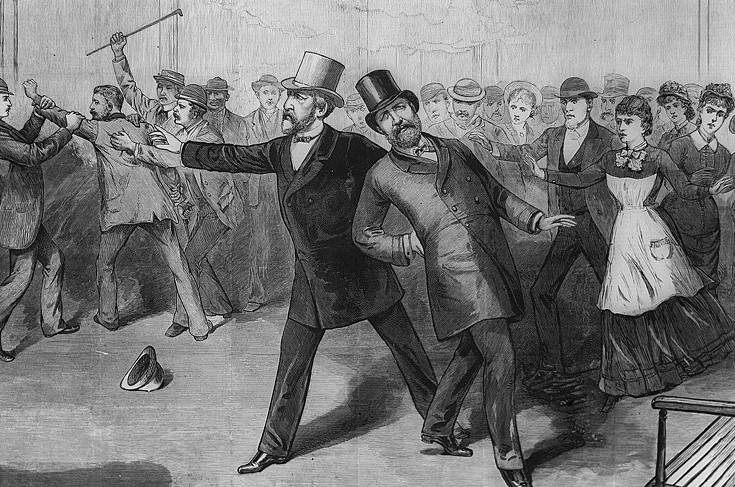
President Garfield Assassination
Alexander Graham Bell devised a metal locating tool to help find the assassin’s bullet in President James Garfield in 1881. The capture device was workable, but didn’t work on this occasion because no one had thought of removing the steel spring mattress the president was lying on. Metal, it turned out, interfered with the devices search. The unsanitary methods used in attempting to locate the bullet caused infection to spread throughout Garfield’s body and he died shortly thereafter.
Here are the final words of a favorite: Oscar Wilde
As anyone who reads this blog knows I love limericks. I love the mild ones written by kids and for kids, the medium ones for many of the limerick loving adults who shy away from many of the naughtier limericks, and occasionally I get in the mood to post something a little raunchier. My favorite limerick writer has always been Isaac Azimov but one of his close friends deserved an honorable mention today. That friend was John Ciardi who for 16 years was the poetry editor for the Saturday Review and his translation of The Divine Comedy is still considered a classic. Sadly, he passed away in 1986 but his works and love of limericks lives on. Enjoy.
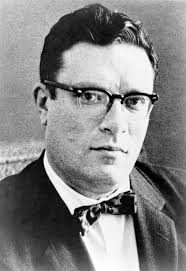
He was an American writer and professor of biochemistry at Boston University. A prolific writer, he wrote or edited more than 500 books. He also wrote an estimated 90,000 letters and postcards. Best known for his hard science fiction, Asimov also wrote mysteries and fantasy, as well as a great deal of non-fiction.
*****
I’ve been a fan of Isaac Asimov, for as long as I can remember. I’ve tried to read everything of his that I could find and have never regretted it. He’s one of the most prolific writers who’ve ever lived and is well-versed in virtually any topic someone would like to talk about. Over the years I’ve also discovered that he was one of the funniest writers as well and has written books of limericks and stories that were outrageously funny. I recently acquired a book of his from 1992 (the year of his death) titled Azimov Laughs Again. It’s a volume of funny stories from his life as well as some of his favorite jokes and limericks. Here are a couple jokes to help get your day started.
Mr. Ginsberg, age 83, went to the doctor for a complete examination head to toe. About halfway through, the doctor was called to the telephone. He said, “Mr. Ginsberg, this will not take more than a few minutes. Here’s a jar. While I am gone, go to the bathroom and place a semen sample in it for examination. Then we’ll continue. “A few minutes later, the doctor indeed returned, and there stood Mr. Ginsberg with the jar- totally empty. “Doctor,” said Mr. Ginsberg. “I did my best. I tried with my right hand, and I tried with my left hand. I even tried with both hands, but nothing happened. The doctor said soothingly, “Now, Mr. Ginsberg, don’t feel embarrassed. At the age of 83, it is quite common to be impotent.” Whereupon Ginsberg said, with towering indignation, “What do you mean, impotent? I couldn’t open the jar.”
Old Mr. Anderson and his equally aged wife were filing for divorce. The judge, eyeing them with astonishment, said, “How old are you, Mr. Anderson?” “Ninety-three”, Your Honor. “And your wife?” “Ninety-one”, Your Honor.” “And how long have you been married?” “Sixty-six years.” “Then why do you want to get a divorce now?” “Well, you know how it is, Your Honor.” We were waiting for the children to die.”
He has an interesting sense of humor and I freaking love it. Here’s a small add-on which is one of his favorite limericks.
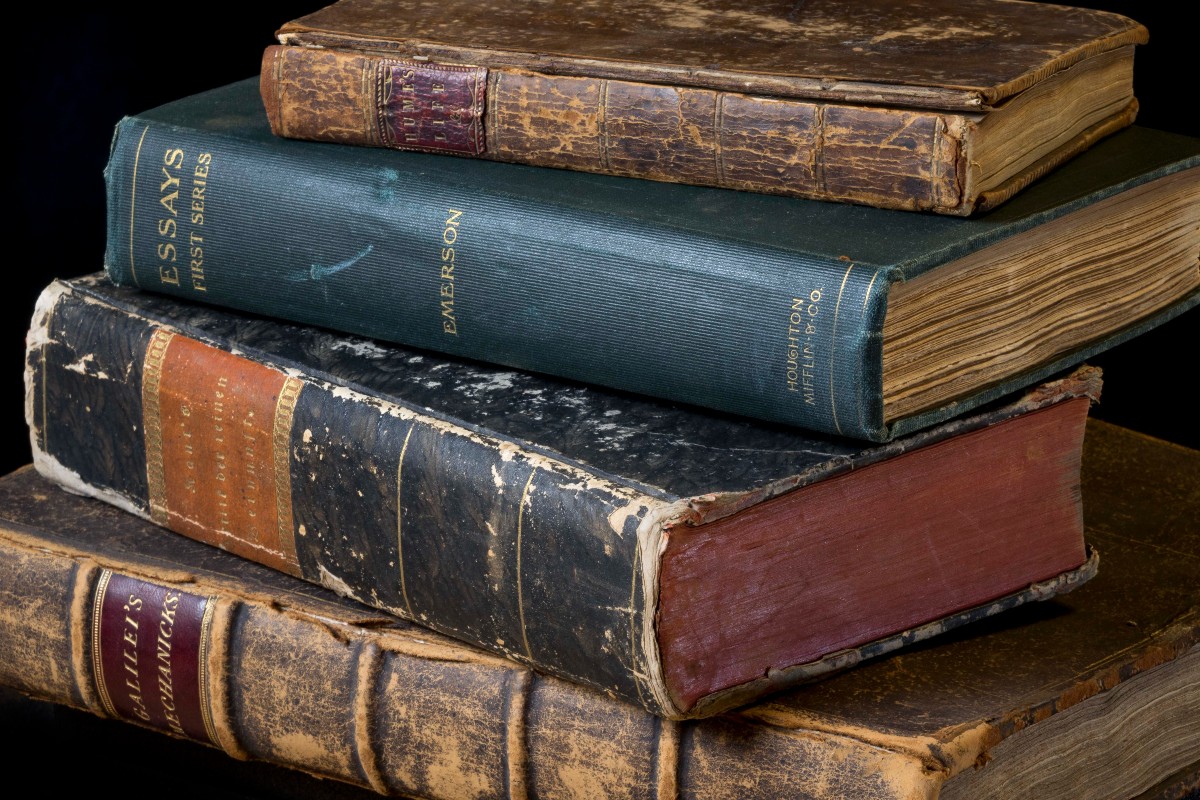
Are you an avid reader? I’ve been one since a very early age and it will continue forever. One of my favorite reads is just about anything ever written by Isaac Azimov. He was a prolific writer as well as a noted intellectual. His areas of interest were many but today I’ll post a few facts he gathered concerning books since we’ve both shared a love for them. Books are great and history is even greater. How can I go wrong posting about the history of books?
Columbus had with him on his first voyage to the New World a copy of Marco Polo’s book about his 13th century, twenty-two-year odyssey to China and back.
Twice as many books on religion were published in England as works of fiction in 1870. Sixteen years later, novels far outnumbered religious works.
The Library of Congress houses over 72 million pieces of research material, including over 16.5 million books and 31 million manuscripts, and costs over $150 million a year to run.
The Communist Manifesto of Marx and Engels was ignored in Germany when it was published in 1848, and a Russian translation was suppressed by censors in the 1860’s. It remained a rare pamphlet until it was reprinted in 1872.
The art of printing from wooden blocks with the characters in reverse was initiated in Buddhist monasteries in China. The oldest surviving printed book that can be reliably dated is a Buddhist text, the Diamond Sutra, made in China in 868 A.D.
Euclid is the most successful textbook writer of all time. His book Elements dated around 300 B.C. has gone through more than 1000 editions since the invention of printing.
General Lew Wallace’s bestseller Ben Hur was published in 1880 and was the first work of fiction to be blessed by a Pope.
America’s first best-selling novelist was a woman, Susanna Haswell Rowson. Although it was a melodramatic work with wooden characters and a hackneyed plot, Charlotte Temple, published in 1791, appealed to popular tastes. It went through more than 200 editions.
Icelanders read more books per capita than any other people in the world.
To get her book published, in 1896, Fannie Farmer had to pay publishers Little, Brown and Company the printing costs for the first 3000 copies. The publisher refused to take the risk, saying that women would not buy still another collection of recipes. Ironically, her Boston Cooking School Cook Book eventually became the most popular cookbook of its time and a “gold mine” through the years for the publisher; millions of copies have been sold in dozens of editions.
I feel the need to distribute a little more useless information today. There seems to a never-ending supply which I will happily make available to as many people as possible. Some of this information was also supplied by my all-time favorite writer, Isaac Azimov.
The foundations of the great European cathedrals go down as far as 40 or 50 feet. In some instances, they form a mass of stone as great as that of the visible building above the ground.
While Columbus was seeking new worlds to the West, Italian engineers were rebuilding the Kremlin in Moscow.
The number of possible ways of playing just the first four movies on each side in a game of chess is 318,979,564,000.
There were more than 100 distinct ethnic groups in the old Soviet Union.
The Pacific Ocean fills nearly a complete hemisphere of the Earth’s surface.
Because of the story in Genesis that Eve had been created out of Adam’s rib, it was widely believed during the Middle Ages that men had one fewer rib than women.
Immediately after the end of the American Revolution, Congress abolished the United States Army, the Navy, and the Marine Corps, leaving the Congress itself as the only national government organization. They feared a standing army.
When Thomas Jefferson became president, in 1801, 20% of the people in the United States were slaves. There were 5 million people in all.
It was only in 1968 – 43 years after the Scopes “monkey trial” – that the state of Tennessee abolished its anti-evolution law and accepted the doctrine of evolution.
“Red Tape” the rigid application of regulations and routine, resulting in the delay in getting business done, got its name from the color of the tape that was commonly used to tie official papers. The term was in use as early as 1658.
Well, for all of you trivia lovers out there you’ve just received your daily fix of totally useless information. My supply never seems to run low and more will definitely follow.
As someone who’s crazy for limericks of all kinds, I thought I’d introduce a new contributor to this blog. The name is John Ciardi, and he was a close friend of Isaac Azimov, my favorite limerick author. They partnered up back in the 70’s and wrote a book of their limericks. It was a limerick war between the two as part of their competitive friendship. I’ve blogged many of Azimov’s limericks and I think it’s only fair to give Mr. Ciardi equal time. Here are a few of his gems.
As I stated on so many occasions, I am a rabid science-fiction fan. I’ve been reading science fiction material since I was a kid when I found a copy of 20,000 Leagues Under the Sea in a box of trash near a neighbor’s home. While admittedly there’s a lot of crap out there calling itself science-fiction, the classics remain the classics. Two days ago, I started reading the Foundation Series by Isaac Asimov again. As a young man I read it the first time but to understand it at that age was difficult. I’ve read the entire series three times since and every time I find more things I missed. As I began to read it again my thoughts came back to Isaac Asimov himself and the fact that he was not only an incredible writer but also wrote many outrageous and bawdy limericks. I thought I pass a few of those along to you today because he really knew how to craft limericks. Here are a few . . .
Everyone who’s ever read this blog for more than a day or two, knows just how much I love limericks. I like them funny, dirty, and filthy. I’ve been collecting them for many years but in a recent book I discovered a gentleman named John Ciardi. He was the second half of the book of limericks authored by Isaac Asimov. They were both lovers of limericks and have written some of the best ones I’ve ever seen. I posted samples of Asimov’s limericks a few weeks ago and today I thought I’d list a few of Mr. Ciardi’s. I know you’ll enjoy them because he takes a lot of time to craft them properly. Here we go . . .
There was a young lady who wouldn’t.
Her mother had told her she shouldn’t.
When dear mama died
She felt free. So, she tried,
but by then she was so old she couldn’t.
There once was a girl from New Haven
Whose pubic hair was not shaven
But missing because
She slept without drawers
Within range of a nest building Raven
There was a young lady named Jo❤
Who always said,” Thank you, but no,”
Which is poised and polite
But never does quite
As well as “Sure, Buster, let’s go.”
😜😜😜
A young do-it-yourselfer once screwed
Two pieces together. If you’d
Like to know what he made,
You must ask Adelaide
And her little sister, Gertrude
🚽🚽🚽
There was an old hooker who blew.
What I mean is, she left town. If you
Understood what I said
To mean she gave head,
Well, I guess there was some of that, too.
I would like to thank Mr. Ciardi for all of his hard work in creating these wonderful limericks. After reading all of his limericks as well as Isaac Asimov’s, it inspires me to begin writing a few of my own again. You can be sure of only one thing, mine will be a little ruder than theirs. Write a few of your own and send them along.
With Christmas now in my rear-view mirror, I can get ready for the coming New Year holiday and celebrations. I won’t be out-and-about myself, but I will have a toast at midnight with my better-half. That being said let me move onto something else that I happen to enjoy, limericks and Isaac Azimov.
I have always been a huge fan of Isaac Asimov. I’ve been reading his novels and articles for most of my adult life. Fortunately for me most of them are science fiction which is my absolute favorite material to read. Asimov was one of the most prolific writers in history. If I recall correctly, he wrote more than 200 novels and thousands upon thousands of novelettes, short stories, and articles in many areas of study. In short, he was amazing.
It wasn’t until 10 years ago that I discovered that one of his hobbies was writing rude and bawdy limericks. After finding that out, I was determined to obtain some of his limericks. I found a thrift bookstore online and after some searching through their inventory discovered a book published in 1978 that contained dozens and dozens of limericks by Azimov and his friend John Ciardi. The book is split into two sections, limericks by Asimov, and the other half are limericks by John Ciardi. It’s a battle of the limerick monsters and makes for some really enjoyable and hilarious reading. I’ll offer up for your entertainment today four of Asimov’s more sexy limericks. I hope you enjoy them because I sure did.
😁😁😁
Sex need not be at all conversational,
Without talking, it’s still inspirational.
But mind you’re not burned
For many have learned
The act can be baby-creational
😜😜😜
Said the husband, with smiling urbanity,
I possess penile super humanity.”
Said his wife,” But the score
Of his inches is four.
The rest of it’s just his insanity.”
😉😉😉
There was a young woman named Cora Lee
Who said,” I will do it immorally
On top and on bottom,
Any way that I’ve got’em,
Vaginally, anally, orally.”
❤❤❤
There once was an eager young nurse
Who felt that she had to rehearse
Every sexual joy,
Every hot little ploy,
To succeed in becoming perverse.
What better way to prepare for New Year’s than a few raunchy limericks? There’ll be many more to come in the new year.













 everyuselessthing.com