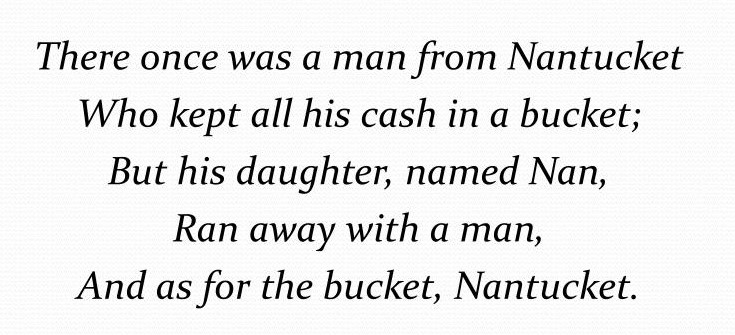
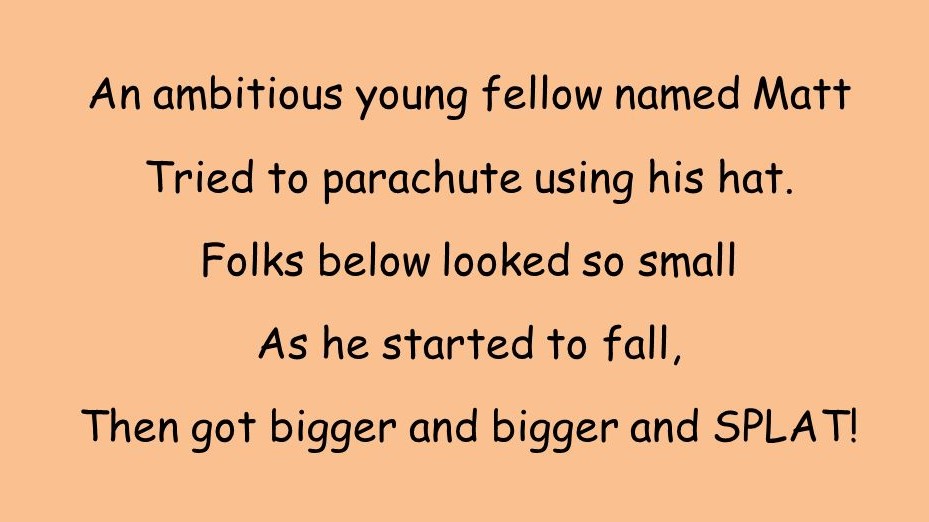
As promised, here is the second installment of David McCord’s limerick writing primer. He not only shows how to write a limerick but gives excellent examples of the various types you can create.
I’m going to introduce you today to a man who was famous for writing limericks, Mr. David McCord. He was also a philanthropist, writer, and poet who held honorary degrees from 22 universities. He was famous for his work in teaching children to write poetry. This first limerick is a short instruction on who to structure a limerick.
David McCord
The limerick’s lively to write:
Five lines to it – all nice and tight.
Two long ones, two trick
Little short ones, then quick
As a flash here’s the last one in sight.
There are 13 limericks published over fifty years ago and were Mr. McCord’s attempt to explain and teach how to write a limerick. Here are the first four. I’ll post a few each day until the entire collection is in your hands. Maybe they will encourage you to write a few of your own.
There once was a scarecrow named Joel
Who couldn’t scare crows, save his soul.
But the crows put the scare
Into Joel. He’s not there
Anymore. That’s his hat on the pole.
💥💥💥
“There was an old man” of wherever
You like, thus the limerick never
Accounts for the young:
You will find him unsung
Whether stupid, wise, foolish, or clever.
A Rare Non-Dirty Nantucket Limerick
There was a young man let me say,
Of West Pumpkinville, Maine, USA.
You tell me there’s not
Such a place? Thanks a lot.
I forget what he did anyway.
💥💥💥
Take the curious case of Tom Pettigrew
And Hetty, his sister. When Hettigrew
As tall as a tree
She came just to Tom’s knee.
And did Tom keep on growing? You bettigrew.
That’s lesson number one for today. If you read them carefully, he gives excellent rhyming tips and how exactly to structure the limerick. More to follow tomorrow.
“Great art is more than a transient refreshment. It is something which adds to the permanent richness of the soul’s self-attainment. It justifies itself both by its immediate enjoyment, and also by its discipline of the inmost being. Its discipline is not distinct from enjoyment but by reason of it. It transforms the soul into the permanent realization of values extending beyond its former self.”
Facing mandatory retirement in London, and upon being offered an appointment at Harvard, Whitehead moved to the United States in 1924. Given his prior training in mathematics, it was sometimes joked that the first philosophy lectures he ever attended were those he himself delivered in his new role as Professor of Philosophy.
I stumbled across a rather large collection of really stupid newspaper headlines this week. I just can’t resist throwing a few of them your way. This kind of stuff just boggles the mind. The first one is the classic screw up and must be seen again.
DEWEY DEFEATS TRUMAN
PROSTITUTES APPEAL TO THE POPE
PANDA MATING FAILS, VETERINARION TAKES OVER
CLINTON WINS BUDGET, MORE LIES AHEAD
MINERS REFUSE TO WORK AFTER DEATH
I especially like the Clinton one. I wonder if the editor got reprimanded. That would have been a big NO-NO for a liberal newspaper. Let’s continue.
COUPLE SLAIN, POLICE SUSPECT HOMICIDE
DEAF MUTE GETS NEW HEARING IN KILLING
QUEEN MARY HAVING BOTTOM SCRAPED
ILLITERATE? WRITE TODAY FOR FREE HELP
LOW WAGES SAID KEY TO POVERTY
It’s hard to believe just how many of these I’ve collected. I should start posting only the ones that are well written and correct. It’s a much smaller number to deal with.
A few weeks ago, I posted about some language oddities called malaprops. To quote a reader who responded to that post, “Those things are like fingernails on a blackboard to me.” So, I thought today would be a good day to run some fingernails over that same blackboard, just for the fun of it. This time I’ll give you a list of malaprops written by grade schoolers, high schoolers, and a few college geniuses. I hope you enjoy them as much as I did.
Louis Pasteur discovered a cure for rabbis.
The walls of Notre Dame Cathedral are supported by flying buttocks.
Sir Francis Drake circumcised the world with a 100-foot clipper.
Moses led the Hebrew slaves to the Red Sea, where they made unleavened bread, which is bread made without any ingredients.
People have sex, while nouns have genders.
Christmas is a time for happiness for every child, adult, and adulteress.
Most words are easy to spell once you get the letters write.
The bowels are a, e, i, o, u, and sometimes y.
The climate of the Sahara Desert is so hot that certain areas are cultivated by irritation.
The United States Constitution was adopted to secure domestic hostility.
A few weeks ago, I promised you limerick lovers some really bawdy and rude limericks. I have quite a collection of those, but I hesitate to post them because it would be really bad if any children were to read them. I recently bought a book from an online thrift store which contains 1001 of the rudest limericks I’ve ever seen. I’m still considering whether to post any of them or at least try to find a few that are a little less objectionable.
Just to give you some idea what I’m talking about I thought I would regale you with an erotic poem written by the author of the book, Mr. Ronald Stanza. This little ditty was copied directly from the rear page of his book cover. Good luck.
❤️
Here now is a steamy collection
Of limericks rare. Each selection
Will run for five lines,
Contain marvelous rhymes –
Detailing sex acts of subtle complexion.
🤤🤤🤤
Though often the rhyming is coarse
And the meter is ragged, or worse.
Positions are randy
The sex is jim-dandy
In this book of libidinous verse.
😋😋😋
Some readers may think that it’s crude
To offer for sale what is lewd
But if you’re offended
By what is appended.
We’ll say what you are: you’re a prude!
😏😏😏
For others the thought of an organ
Of sex is a scream. And it’s sure fun
To peep and to poke
And make sex a joke.
If a fault, it’s delightfully human!
🍆🍆🍆🍆🍆
The more I read this little ditty the more I like it. A special thanks goes out to Mr. Ronald Stanza for his fine work. I’ll let you know about the final decision on the week of lewd limericks in a few days, but it isn’t looking good.
A few months ago, while I was surfing on eBay, I purchased a number of books on a whim. In one of those books, I discovered it was a library book from the North Side School Library in Rogers, Arkansas dated 1965. The book contains limericks written by quite a variety of people, some well-known some not so much. They’re funny and cute and dated. I hope they bring a smile to your face as you read them. Here we go . . .
Edward Lear
There was an old man in a tree,
Who was horribly bored by a bee.
When they said, “Does it buzz?”
He replied, “Yes, it does!
It’s a regular brute of a bee.”
😁😁😁
Ogden Nash
There was an old man of Calcutta,
Who coated his tonsils with butta,
Thus, converting his snore
From a thunderous roar
To a soft, only oleaginous mutta.
😛😛😛
Lewis Carroll
His sister named Lucy O’Finner,
Grew constantly thinner and thinner,
The reason was plain,
She slept out in the rain,
And was never allowed any dinner.
😉😉😉
Rudyard Kipling
There once was a small boy in Québec
Stood buried in snow to his neck.
When asked: “Are you friz?”
He said: “Yes I is,
But we don’t call this cold in Québec.”
😋😋😋
Carolyn Wells
A canner, exceedingly canny,
One morning he remarked to his granny,
“A canner can can
Anything that he can,
But a canner can’t can a can, can he?”
As you can see, some of these people were famous but that was 57 years ago. The limericks were mostly written in the late 1950’s and early 1960’s.
Poetry is an enigma to me. I wouldn’t know good poetry if my life depended on it and even the bad poetry that I sometimes see doesn’t sound so bad. Anything that confuses me like that makes it impossible for me to take it too seriously. After a recent Bad Poetry Post, I received a few e-mails with samples from some of my readers. I assume they sent them because they thought they were bad, I don’t really know, so you figure it out. I think the first one was sent to me because I’m from Maine and someone thought I might be interested in Moose poetry. Good luck with that one. Here it is . . .
A moose is like a bull on stilts With a silly kind of head. And if one of them sat on you You’d probably be dead.
Do you really think that’s bad poetry? It seems okay to me but nothing special. It’s a little bit of truth with a little bit of silliness. Here’s the next one which I really don’t understand about a Toad. It’s a little weird but kind of funny. It seems more like a limerick than poetry but when you get right down to it there isn’t much of a difference.
The story that is told By a severely flattened toad, Is of evidential failure In attempts to cross the road.
This next poem hits home for me primarily due to my advanced age and secondly because it brings back memories of my favorite grandmother who passed away a very long time ago. See what you think.
💖
Of love and marriage who can say, which way these things can go. A loving wife, a shrieking hag, no one will ever know.
The years of youth have come and gone, with memories good and bad. The happiness of family, the love of mom and dad.
The years should teach you something, or so we’re always told. Remain yourself no matter what, and mellow when your old.
Your life is filled with happiness, and sorrows big and small, But not until your old and gray, will you understand it all.
It is a shame that through the years, this knowledge lies unused. Erring and blundering again and again, with help and advice refused.
So, think about the elder ones, grandmothers, grandfathers and such, Who’ve experienced life’s many problems, and could help you oh so much.
Their days are few in number, and once their gone it’s sad. Accept their help and listen close, to the experiences that they’ve had.
And when they’ve gone, you’ll think of them the way they used to be. The memories are all you have, but that’s enough you see.
Most of you readers enjoy the limericks I post but even more seem to enjoy the limericks created by kids. Here are a few more selections for your amusement.