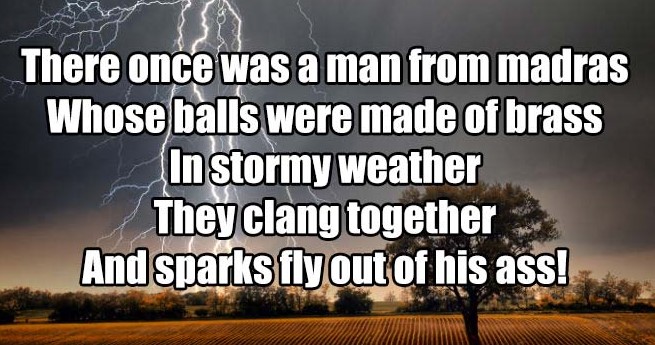
It’s just another weird and wonderful week here in Maine. So far, we’ve had a snowstorm, then an earthquake, then a windstorm, then some rain, and a dose of black ice for good measure. It’s no wonder I hate to leave the house. Today’s post is yet another visit through the “limericktime tunnel“. These limericks were probably compiled sometime in the mid 1970’s and then published in the early 1980’s. I love looking back to search for a few interesting and funny gems that need to be redistributed to the newer generations. Enjoy!
Another freezing cold day here in Maine. I don’t feel as bad about it as I normally do because I can spend my day watching videos of the folks down south enjoying the snow with their families. My favorite so far came out of south Louisiana where the roads had been closed to car traffic. One genius soul braved the snow squalls and rode down the main street of his town on a swamp air boat. Too cool for school! Today’s quiz will be about artists, a favorite topic of mine. Answers will be listed below.
The “Gibson Girl” made famous by artist Charles Dana Gibson, was what woman?
Fulton, Missouri, has a thirty-two-foot sculpture titled “Breakthrough“. What cold war relic does it commemorate?
If you wanted to see a lot of paintings of dogs, what midwestern city would you visit?
What famous female painter started painting because her fingers had become too stiff for embroidering?
What great artist signed his pictures with a sketch of a butterfly?
What great French sculptor’s works are featured in a Philadelphia Museum?
Grant Woods famous painting, American Gothic shows a farm couple, with the man holding a pitchfork. What relation are the man and woman?
What huge outdoor sculpture was created by Gutzon Borglum?
What president’s much visited statue in D.C. was sculpted by Daniel Chester French?
Californias most famous cemetery has several large reproductions of famous religious paintings. What is the cemetery?
Answers
Gibsons wife, The Berlin Wall, St. Louis’s Dog Museum, Grandma Moses, James Whistler, Rodin famous for “The Thinker“, Father and Daughter, Mount Rushmore, The Lincoln Memorial, Forest Lawn in Glendale.
Now that the new year has begun and the obligatory resolutions have been posted, I thought it would be nice to return to one of the mainstays of this blog, LIMERICKS! I have a large and varied collection but today I’ll be reaching way back to 1979 for some inspiration. I hope you enjoy them.
I was really disappointed with my terrible showing on the 2024 New Years resolutions. Barring any unforeseen catastrophes I hope to do much better in 2025. I admit that my bout of laziness during those warm summer months didn’t help. I just had too many distractions!
*** HERE THEY ARE FOR 2025***
Read at least 100 books by years end(more if possible).
Complete at least four illustrations for use as gifts for next Christmas.
Complete one sculpture using a technique I haven’t used before.
Show more patience to my better-half’s retirement adjustments.
Attempt to write some serious poetry that’s worth reading.
Continued monitoring of the grandsons for new and exciting cuss words. (Minimum of 1)
Continue to ignore all of the weird and bizzare health tips from the Internet. (This one is too easy.)
I plan on being more serious about completing the resolutions this year. I’ve always set goals for myself for most of my life with a great deal of success. This will be a lot more fun because the only person looking over my shoulder these days will be ME!
There are times that self-reflection can be a dangerous and disappointing endeavor. As you get older you will tend to spend a great deal of time reviewing your life. If you’re a truthful person (at least to yourself) you may discover a number of things that aren’t all that wonderful. I thought for most of my life that I was quite the romantic. I was never going to be a Don Juan, but I thought I was able to hold my own in that department. I’ve finally came to the realization that I may have been mistaken. After all my years of reading, writing, and talking with thousands of people, it finally became clear that I was somewhat lacking in that area. Today’s post is a short collection of poetry by some well-known people whose romantic writings put mine to shame.
By Franz Kafka, “From A Letter to Milena Jesenska”
I am just walking around here between
the line (of my letter), under the light
of your eyes, in the breath of your
mouth as in a beautiful happy day.
❤️❤️❤️
By Lorrie Moore, 1957
Need: Something to lift you from your boots
out into the sky, something to make you like
little things again, to whirl around the
curves of your ears and muss up your hair
and call you every day.
❤️❤️❤️
By Elizabeth Jennings, 1916, from “Absence”.
It was because the place was just the same
that made your absence seem a savage force.
For under all the gentleness there came
an earthquake tremor: fountains, birds
and grass were shaken by my thinking
of your name.
❤️❤️❤️
By Ralph Waldo Emerson, from “Thine Eyes Still Shined.”
I’ve spent most of my day dealing with a belligerent computer program that refuses to do its job. I shouldn’t be too upset since it’s a program I purchased about 10 years ago. I suspect that it has finally gotten to the point where my new computer is more than it can handle. It was a program used to write what I spoke. Now I’ll be forced to step back a few years and begin typing everything myself. I suppose I’ve gotten a little lazy over the years relying on that software. That being said I’m posting a few limericks today that were originally written sometime prior to 1960. Enjoy them unedited.
I’m feeling a little lazy today because I’ve spent the last 24 hours watching my better-half also known as the Christmas Elf lose her mind. She’s been pulling containers of Christmas memorabilia from the attic by the arm load. I know if I stand still for more than 5 minutes, I’ll be draped in garlands and blinking lights. We’ve got a huge assortment of lights purchased over the years, we got a mile of garlands, and an incredible number of little elves and holidays knickknacks on every available surface. I wish I was exaggerating but I’m not. I’m hiding in my man-cave attempting to keep a low profile and to keep Christmas from overflowing into my private space. I’ve been successful so far, but I hold little hope that it will last. It’s not that I’m a Christmas Grinch but I’m nowhere near as nuts about the holiday as she is.
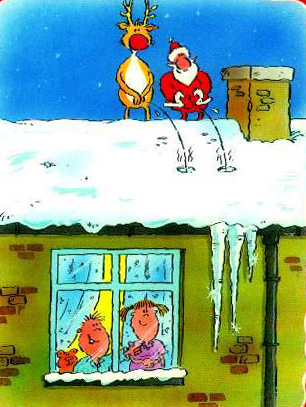
I tried to hide yesterday but she kept finding me. Before I knew it and before I can say too much, I was assigned the duties of putting up the tree. Then there were the endless Christmas carols that she was singing to me while she prepared boxfuls of goodies that she’s sending to people and family all around the country. She’ll probably spend more money on shipping those boxes than she did on the gifts contained in them. I’m sure she sees it as her contribution to keeping the Postal Service profitable and I’m sure they’ll really appreciate her concern and generosity. My only contribution so far to the Christmas spirit of the household is contained in this cartoon from a few years ago that I saved and it pretty much describes my thoughts on this entire matter. LOL
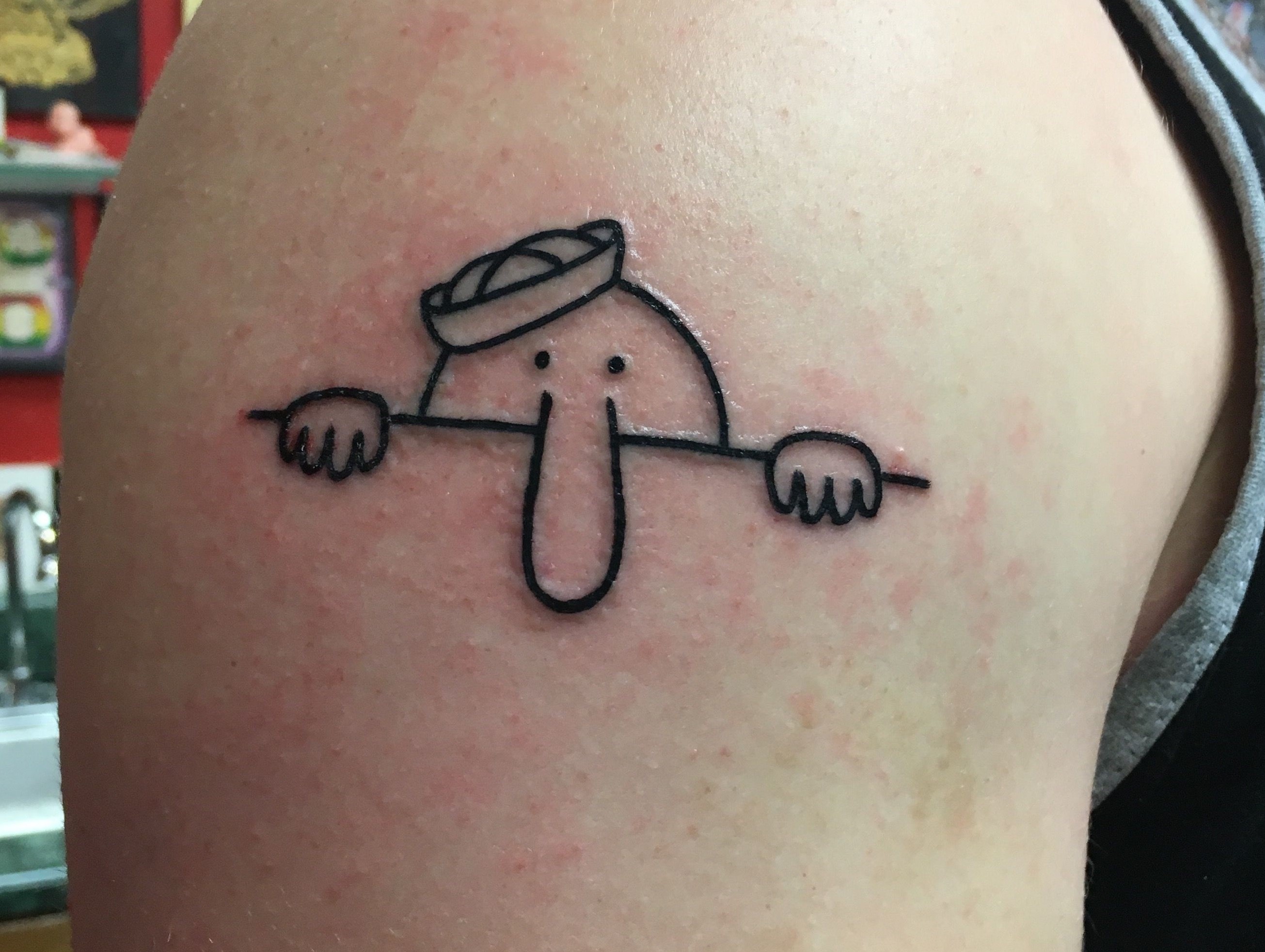
I’m reasonably sure that most of us are familiar with the saying “Kilroy was here.” I’m also sure that most of us (especially non-military folk) haven’t a clue where it came from and how it’s managed to survive since its creation early in World War II. Here’s part of that story . . .
The exact creation of this image has never been discovered. It began appearing early in World War II and was found on ships, railroad cars, bunkers, fences, the occasional fighter plane, bombs, and the occasional torpedo.
In 1946, just after the war ended, the American Transit Association began a search for the real Kilroy and offered a real trolley car as the prize. Approximately 40 men tried to claim the prize, which was eventually awarded to 46-year-old James J. Kilroy of Halifax, Massachusetts. The judges thought that his story was the most convincing. During the war, Kilroy was an inspector at the Bethlehem Steel shipyard in Quincy, Massachusetts, that produced ships for the military effort. Kilroy discovered that he was being asked to inspect the same ship bottoms and tanks again and again, so he devised a way to keep track of his work. He used a yellow crayon and wrote “Kilroy was here.” in big block letters on the hatches and surfaces of the ships he inspected. The same ships then made their way overseas with Kilroy’s inscriptions intact. Also, over the course of the war, 14,000 shipyard employees also enlisted, most of whom went overseas as well. No one knows who first decided to imitate the crayon scrawled words, but before long, soldiers saw them everywhere. It became common practice for the first soldier into a new area to pull out a piece of chalk and let those behind him know that Kilroy had already been there too.
True or not James J. Kilroy story convinced the judges and won the contest. What did he do with the trolley car? Kilroy had a big family, so he attached a 50 foot long, 12-ton trolley car to his house and used it as a bedroom for six of his nine children.
Just as an aside, I can’t tell you how many times when I was in the Army both here in the US and overseas, I discovered very quickly that “Kilroy was (already) here.” It was scrawled everywhere. Once while in Korea I was climbing through a deserted gun emplacement in the hills near Inchon. There was old graffiti on the walls from some Turkish soldiers which I couldn’t read and right next to them was a huge “Kilroy was here!” Most recently and most poignant was this magazine photo taken at the home of Osama bin Laden just after his capture.
TRUTHFULLY, I CONFESS TO PLACING “KILROY” ON A FEW THINGS MYSELF.
With Halloween on the horizon, I thought I’d give you a dose of weird. Just a few little tidbits of bizarre things that humans insist on using as an excuse for questionable behavior. Here we go . . .
In January of 2008, an 81-year-old Chilean man woke up at his own funeral. His family dressed him in his finest suit and laid him out for a proper way, only to witness him opening his eyes midmorning. Upon waking he simply asked for a glass of water. The family was overjoyed.
The Dunkenfield Crematorium in Manchester, England, once asked local residents and clergyman to support its plan for heating and powering its chapel and boiler using the heat created by burning bodies.
“It rubs me the wrong way, a camera . . . It’s a frightening thing
. . . Cameras make ghosts out of people.”
Bob Dylan
In Paris in the 20th Century, Jules Vern describes the Paris skyline dominated by a large metallic structure. The book was written in 1863, years before the Eiffel Tower was even conceptualized in 1887.
The state of Idaho has enacted a provision known as the “Ghost in the Attic” statute, which went into effect in 1998. It states that neither the homes seller nor the seller’s broker is liable for not disclosing that the property may be haunted. Even if the house is the site of a known suicide or homicide, the seller need not disclose this fact unless the buyer specifically writes to the seller and inquires.
Triskaidekaphobia is a morbid fear of the number 13 or the date Friday the 13th. In early Christianity, the number thirteen was considered unlucky because it was the number of persons present at the Last Supper, and the day Friday unlucky because Christ was said to have been crucified on a Friday.
In you love candles you need to know these following facts since they have always been shrouded in mystery and superstition.
If a candle blows out during a ceremony, it’s a warning that evil is nearby.
Three lit candles in a row are bad luck, so be sure to blow one out if you see them.
Light a candle inside jack-o’-lantern on Halloween to guard against evil spirits that are lurking about.
If you look into a mirror by candlelight, you are risking bad luck, but you might also find the souls of the dead there.
A cork candle is a small, sourceless flame that floats through the night air and is believed to be a lost soul. The sight is considered an omen of death.
“Some of mankind’s most terrible misdeeds have been committed
under the spell of certain magical words or phrases.”












 everyuselessthing.com